It is becoming increasingly important that new staff go through the onboarding process efficiently and are trained in a targeted manner. A project by TEAM GmbH and the Organisational Behaviour research group at Paderborn University as part of Arbeitswelt.Plus shows how a structured preparation of knowledge can secure the expertise of experienced professionals and make onboarding processes more efficient.
Implicit knowledge is a strategic success factor
In the next few years, the baby boomers will retire. News studies assume that the German labour market will lose a total of 12.9 million workers by 2036. As a result, companies run the risk of important tacit knowledge leaving the organisation.
Especially in the position of a project manager of the transfer partner TEAM, an employee must combine extensive knowledge from the fields of intralogistics, IT technology, functionalities and processes of the ProStore® product, project management methods and the management of ProStore® projects. The IT solutions are often highly customised, which is why the onboarding process for new project managers is time-consuming and complex. The content of the induction programme is clearly defined, but it often also requires in-depth expert knowledge from experienced employees. With the imminent departure of experienced employees, there is an acute need for action to rethink this transformation process. AI is seen as a promising way to support this process. However, the use of this technology brings with it socio-technical challenges.
Structured processing of knowledge using AI
The aim of the transfer project was to create a blueprint for how knowledge can be extracted, stored and processed within the company. In addition to the existing documentation, this knowledge should form the basis for an AI-based support system that accelerates the familiarisation of new employees and completes the knowledge documentation.
To this end, a customised methodological approach was developed together at the start of the project and the knowledge transformation process was outlined. In order to ensure a practical approach, it was crucial to include the perspectives of the knowledge carriers. Paderborn University therefore conducted numerous expert interviews in order to 1) map the current situation of knowledge management in the company, 2) evaluate the planned approach and receive constructive feedback and 3) involve employees in the development of the AI at an early stage in order to increase acceptance and willingness to use it.
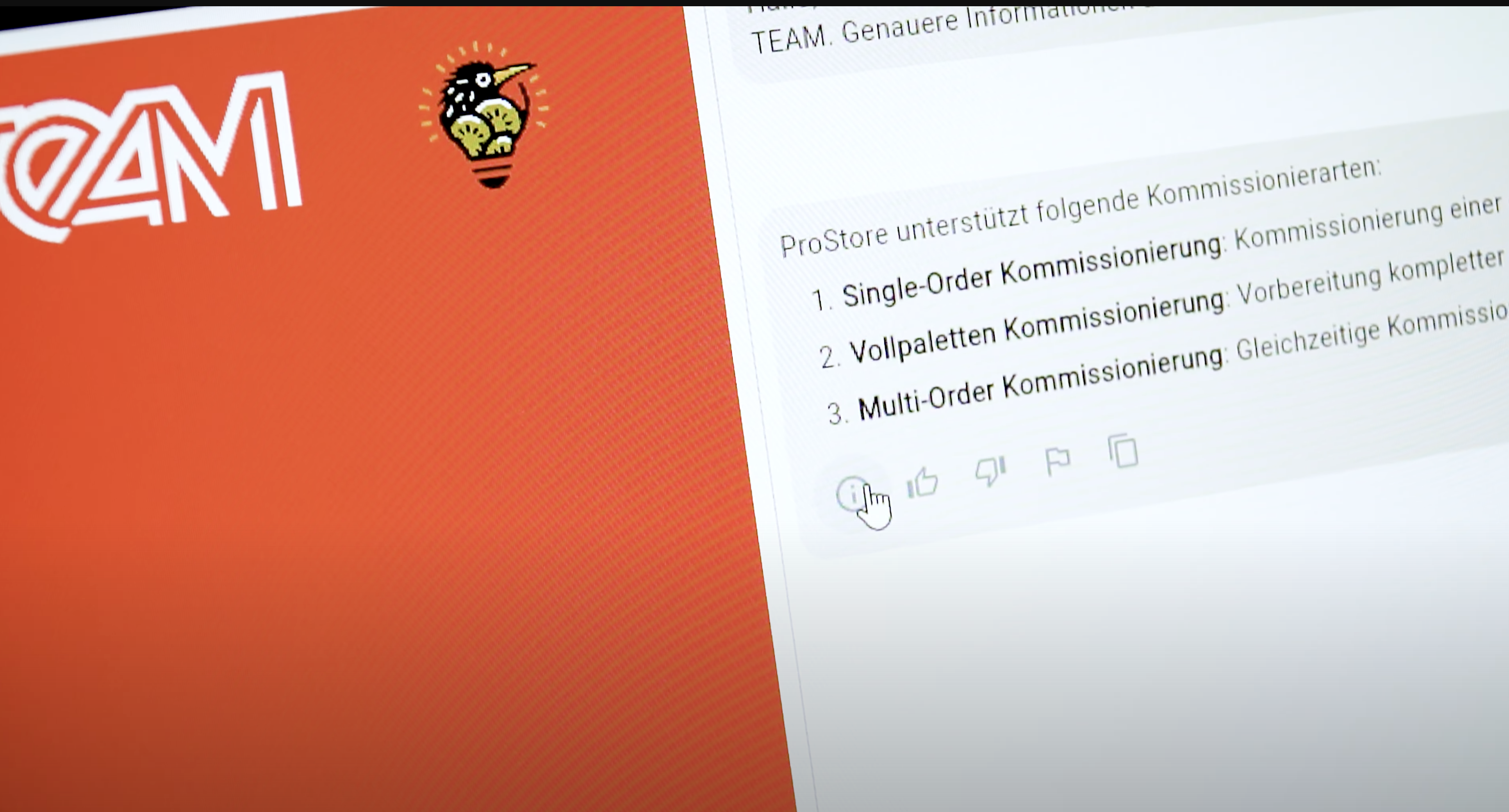
The development of the AI for knowledge transformation (KIWI for short) began with the identification of relevant knowledge documents (e.g. specifications, manuals, QM documents). Technically, the partners decided to design the system according to the RAG architecture (Retrieval Augmented Generation) and to read in the knowledge sources in a structured manner using defined metadata. The KIWI interface was structured like a chat. With the support of experienced employees, typical ProStore® questions were then created that KIWI had to be able to answer correctly based on the knowledge sources read in. The answers were then assessed by experts using school grades. Based on this feedback, targeted technical improvements were implemented in an iterative development process (e.g. selection of the LLM, embedding model, filter options, chat history), thereby gradually improving the AI. At the end of the process, the average response quality was increased from "sufficient" to "very good".
Finally, KIWI was validated with real questions from new employees. At the beginning of the project, they were asked to write down typical questions in a catalogue that they would otherwise have asked experienced colleagues. This catalogue was then read into KIWI and the answers were checked again by experts to ensure they were correct. Inadequately answered questions were then analysed in order to identify possible knowledge gaps and close them with the help of expert knowledge.
In summary, it can be said that KIWI simplifies and accelerates the collection and organisation of knowledge in the company and sponsors further knowledge creation and transfer. The use of KIWI is now being extended beyond the project to other areas of the company.