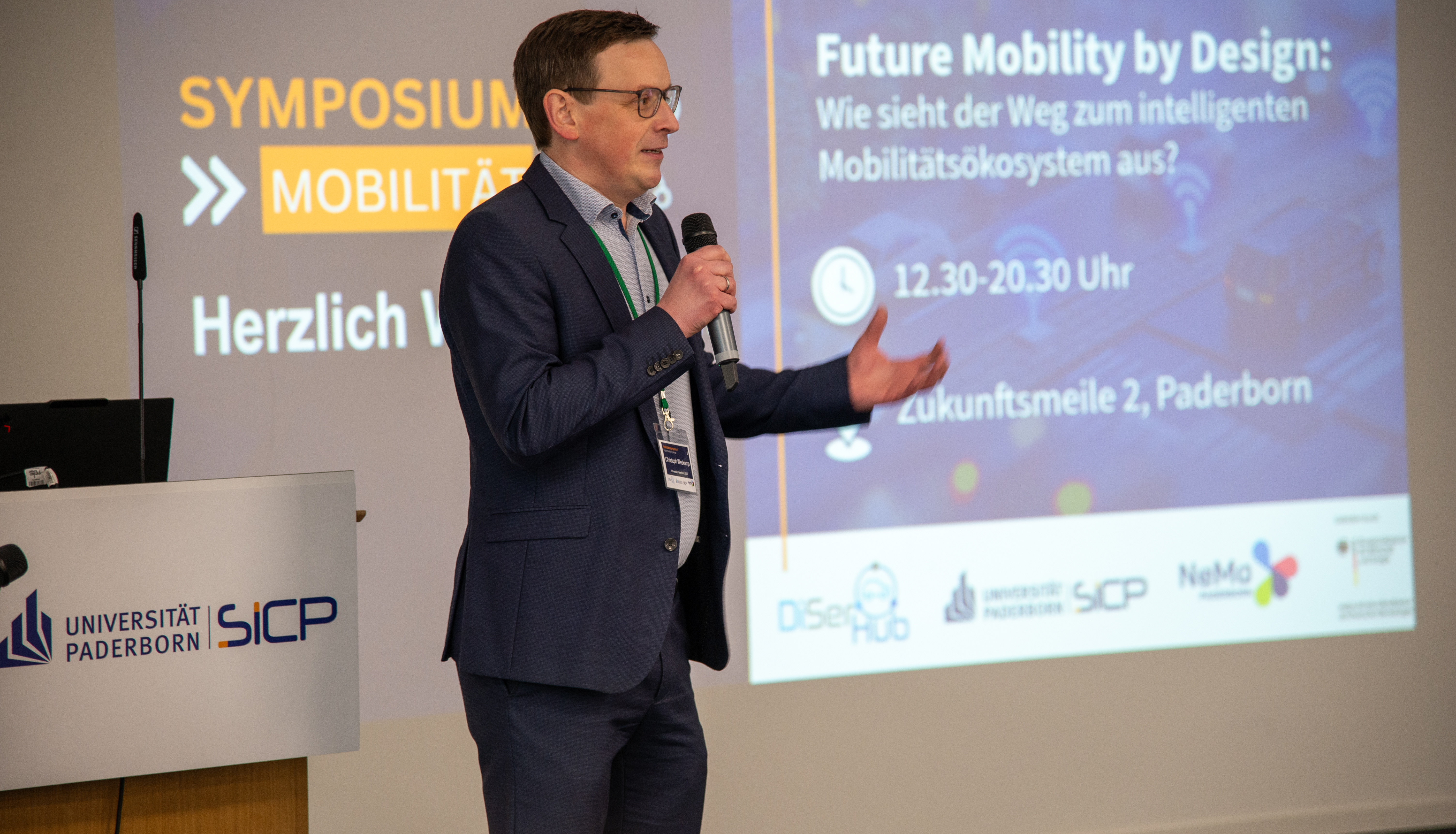
At the mobility symposium at the Zukunftsmeile 2 research and innovation campus in Paderborn, over 100 stakeholders from business, research and the public sector came together to discuss innovative mobility solutions at the invitation of Paderborn University's SI Lab and the Neue Mobilität Paderborn (NeMo) association. The specialist event took place in the context of the "DiSerHub" transformation hub funded by the Federal Ministry for Economic Affairs and Energy, of which the university is a member of the consortium.
The symposium focussed on the question of how an intelligent, data-driven and networked mobility ecosystem can be designed and scaled in concrete terms. After a welcome address by Dr Christoph Weskamp, Head of the Seamless Mobility innovation unit at Paderborn University's SI Lab, NeMo Managing Director Jonathan Behm and Prof Dr Thomas Tröster, Vice President for Research and Academic Career Paths at Paderborn University, the focus shifted to keynote speeches and workshops. The key questions discussed included how vehicle data can be used economically, the role of AI agents in rail transport and the regulatory, technical and economic hurdles that still need to be overcome in autonomous driving in Germany.
Prof Dr Ulrich Büker from the Ostwestfalen Lippe University of Applied Sciences provided a practical insight into the current state of autonomous mobility. The NeMo.bil, MonoCab and Ultimoverprojects presented made it clearthat autonomous driving is no longer a vision of the future, but is already being tested today - albeit not yet at the level of large-scale RoboTaxi concepts. Dr Jens Knodel from CARUSO emphasised that it is not only the vehicles that are decisive for scaling, but above all data access and data ecosystems: using the experience of the past decade as an example, he showed how data marketplaces can act as the "engine" of a mobility ecosystem - by making telematics data from connected vehicles available, usable and economically exploitable, thus enabling new use cases and business models. In his presentation, Dr Nicolai Erbs from T-Systems showed how AI agents can relieve the burden on existing nationwide rail transport, for example by improving train scheduling and thus reducing delays - and at the same time pointed out ethical pitfalls in the use of AI. The user's perspective also played a central role. Prof Dr Kirsten Thommes, Professor for Organisational Behaviour at Paderborn University, made it clear that data-based mobility solutions are only effective if decisions made by AI systems remain comprehensible and explainable to humans.
Stakeholders need to be convinced to invest in autonomous mobility
Jann-Eve Stavesand, Head of Product Portfolio Management at dSPACE and board member of the "Ecosystems Mobility 4.0" initiative funded by the German Federal Ministry for Economic Affairs and Energy, provided an important impetus. He emphasised: "The biggest challenge is not technological development, but above all the establishment of viable business models for autonomous mobility. Many players from different fields need to be convinced to invest in autonomous mobility solutions."
As this willingness to invest is still limited, Ecosystem Mobility 4.0 is pursuing the long-term goal of establishing autonomous mobility as a key pillar for Germany and Europe as a centre of business and industry. "To achieve this, we are bringing together previously loose mobility projects in a holistic organisation," says Stavesand. "Close cooperation between research and development, users and industry is crucial." The overarching question remains: How can the transition from individual pilot projects to scalable, economically viable solutions be achieved? This is precisely where the DiSerHub transformation hub comes in.
"In the DiSerHub transformation hub, we bring together industry, the public sector and science to develop new digital services and business models for connected, autonomous driving," says Dr Christoph Weskamp. "We are looking at the entire ecosystem, because it is not just the AI in the car that determines success, but the interplay of digital services across all partners: if a vehicle detects slippery roads or an obstacle, this information is validated as a data service, sent to other road users and the infrastructure and flows into live updates for routing and maps - making autonomy operable, safe and economically scalable."
The mobility symposium clearly showed that there is great interest in realisable solutions. The task now is to consistently develop and scale up existing approaches such as the NeMo.bil on-demand mobility system in the real-world laboratory.