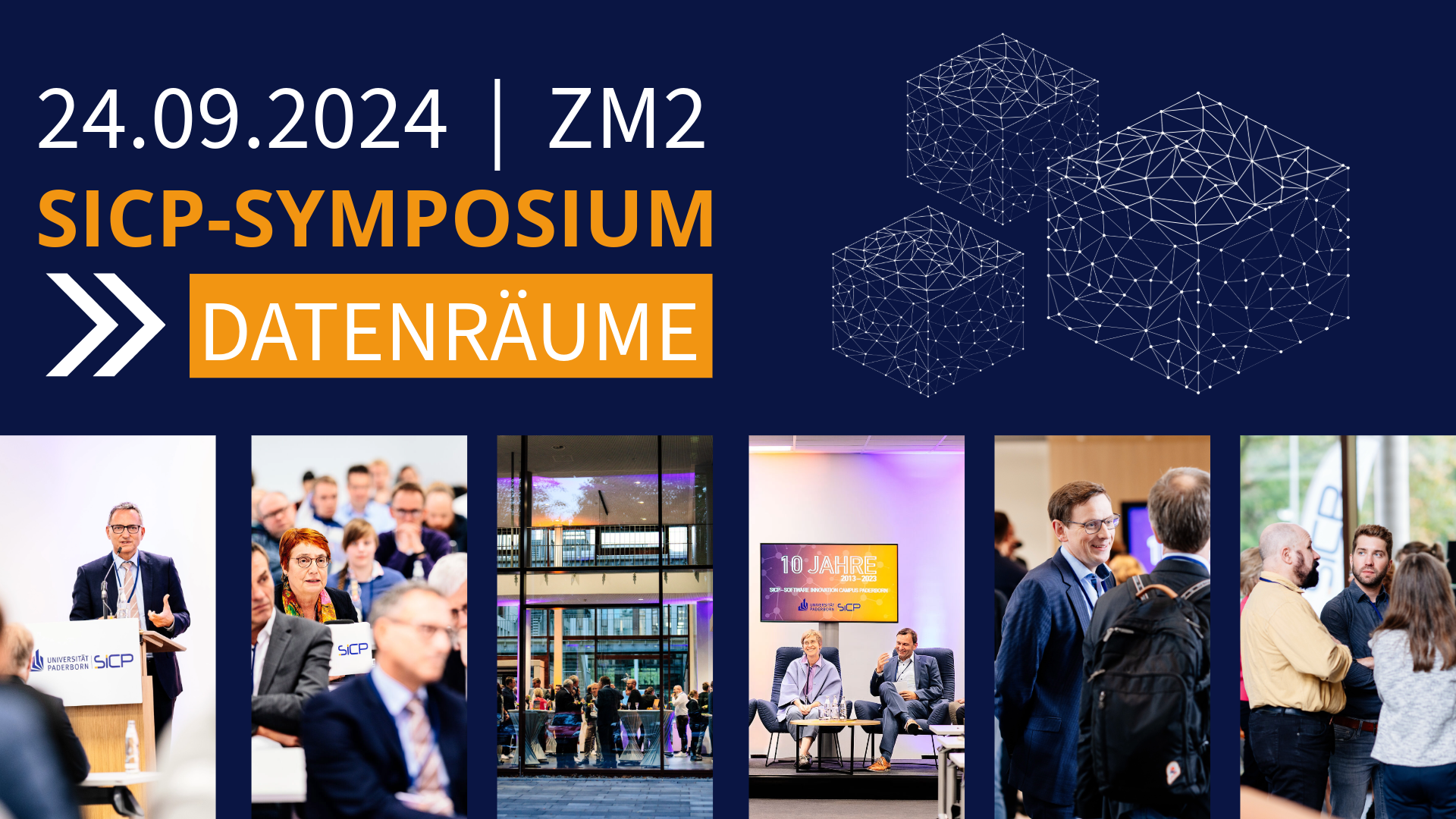
The SICP - Software Innovation Campus Paderborn invites you to this year's SICP Symposium on Tuesday, September 24, in Paderborn's Zukunftsmeile 2 in order to promote the exchange between science and business on the forward-looking topic of “data spaces”. The event will focus on the question of how to develop a competitive data economy that preserves digital sovereignty in Germany and Europe. Participation is free of charge. Registration is open until Friday, September 13. Further information and the registration link can be found on the event page.
The symposium consists of numerous presentations by experts as well as a panel discussion and interactive workshops. Among other things, it will address the questions of how data spaces influence the digital transformation of companies and what contribution the SICP makes to the topic with its multidisciplinary, socio-technical focus. Prof. Dr. Beate Flath, Professor of Event Management at the University of Paderborn, Ulrich Ahle, Chief Executive Officer of the Gaia-X European Association for Data and Cloud AISBL, Gerald Lobermeier, Program Management Product Data for Customers at Phoenix Contact, and Prof. Dr. Frank Köster, Professor in the Department of Computer Science at the Carl von Ossietzky University of Oldenburg and Founding Director of the Institute for AI Safety at the German Aerospace Center (DLR), have already been confirmed as speakers.
Data rooms promote transparent networking
Data spaces are digital infrastructures that enable the self-determined sharing of data in accordance with European legal standards and in line with the EU's Data Governance Act. The aim is to create a culture of trust on the internet on this basis. The “Mobility Data Space” initiated by acatech - National Academy of Science and Engineering serves as a reference model and catalyst for the development of data spaces. A number of promising projects are currently being developed, for example for archives. One flagship project that the SICP is helping to shape, for example, is the “Data Space Culture”, which was launched last year. The data room connects cultural institutions, the media and creative industries as well as IT research in order to create fair digital infrastructures that facilitate access to data and its reuse for those interested in and working in culture.