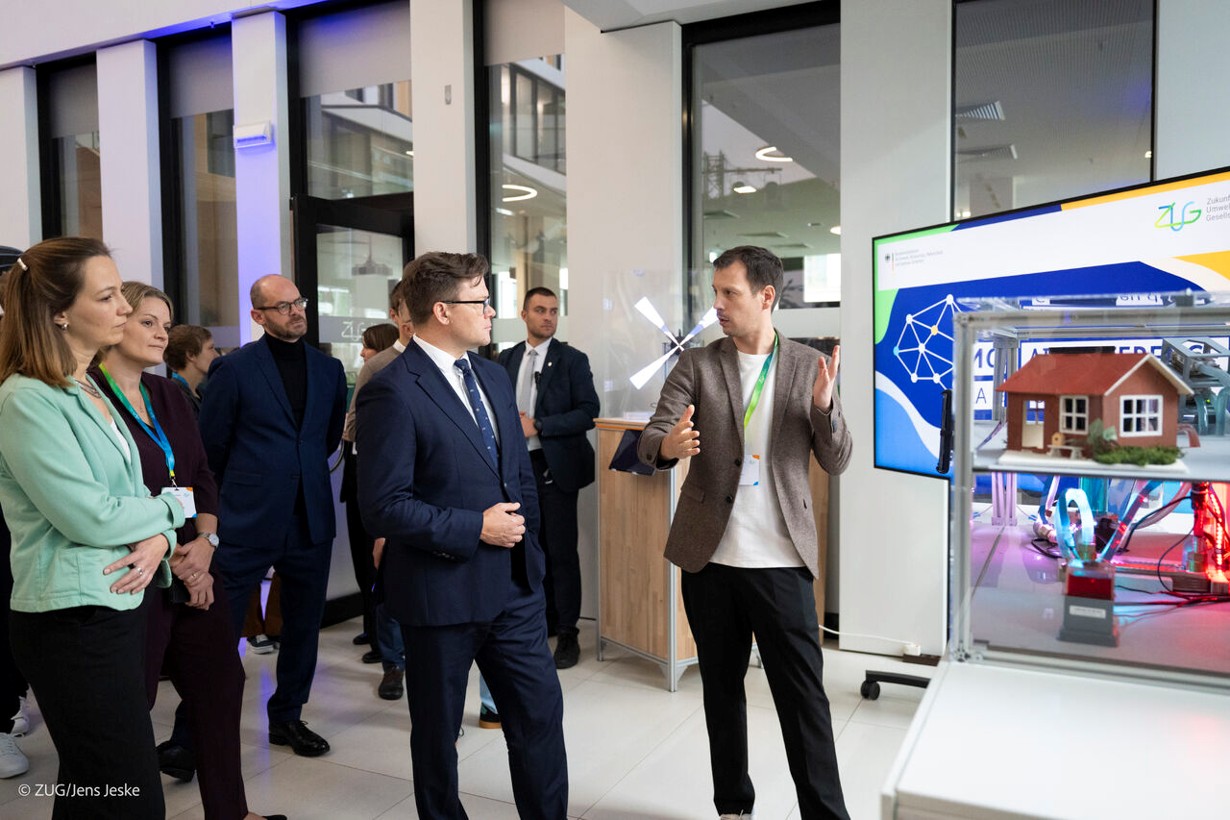
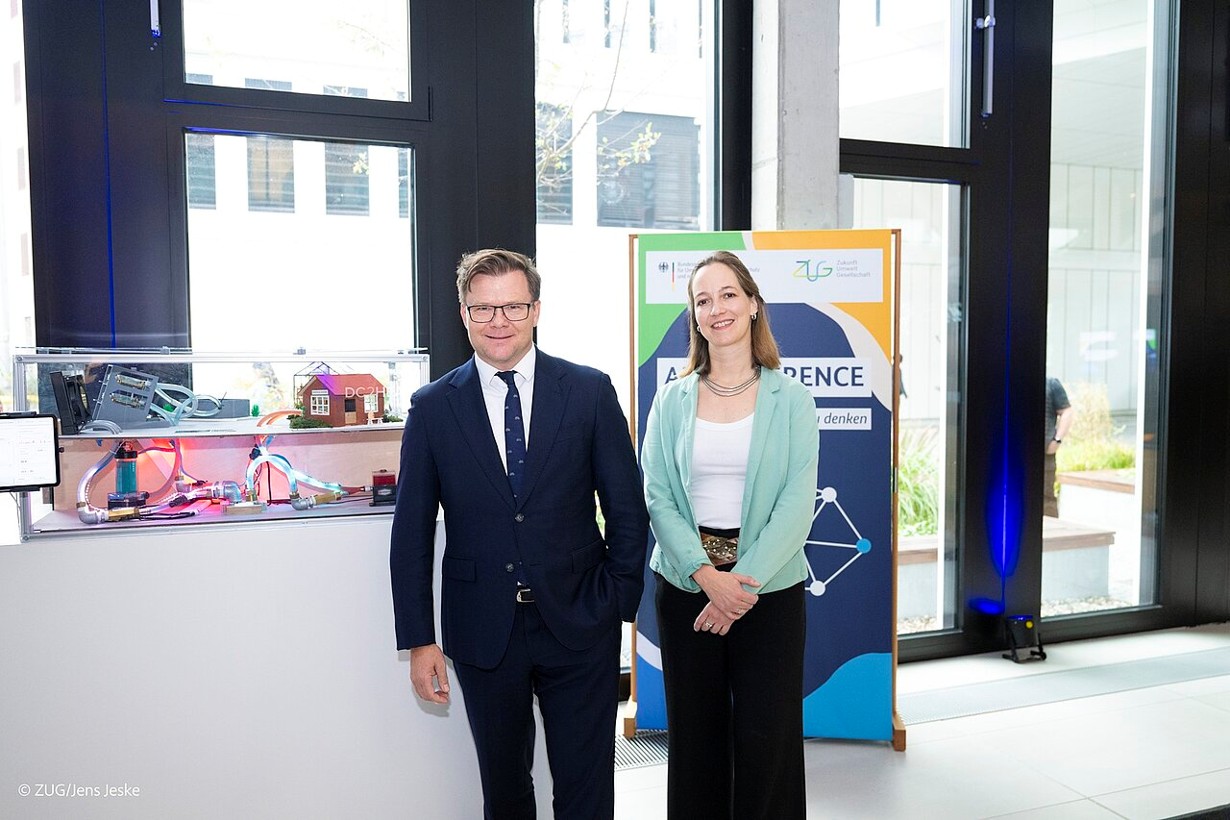
How can artificial intelligence help to utilise waste heat from data centres for heating? This was demonstrated by the DC2HEAT research project at the AI Conference 2026 in Berlin. Federal Environment Minister Carsten Schneider visited the project stand and was given an explanation of the project by Marcel Meyer, a research assistant at the Chair of Business Informatics, specialising in Data Analytics.
Prof. Dr Oliver Müller’s department presented DC2HEAT together with the department headed by Prof. Dr-Ing Henning Meschede (Energy Systems Engineering). Marcel Meyer and Denis Divkovic, a research assistant in Energy Systems Engineering, were on site with two demonstrators. The conference organised by the Federal Ministry for the Environment took place on 6 October 2026 under the motto ‘Rethinking Green AI’ at Zukunft – Umwelt – Gesellschaft (ZUG) gGmbH.
DC2HEAT develops intelligent digital twins to support the planning and operation of systems for utilising waste heat from data centres. The aim is to make efficient use of the heat generated for heating purposes and thereby reduce the use of fossil fuels.
In his opening speech, the Minister emphasised that the use of data centre waste heat can make an important contribution to a more sustainable data centre infrastructure and to local heat supply. He also referred to the exhibition display on AI-supported waste heat utilisation that he had visited earlier.
For the SICP – Software Innovation Campus Paderborn, this presentation is a fine example of its work in the field of science communication: DC2HEAT combines expertise from the energy sector, data centres and AI, and is correspondingly complex. Clear and illustrative demonstrators make this complexity accessible even to non-specialists and decision-makers, opening the door to discussion.
In addition to the presentation, the conference provided an opportunity for many interesting discussions centred on DC2HEAT. The lively exchange with the other AI flagship projects regarding their initiatives and the use of AI for environmental and climate protection was particularly valuable.
The day before, Marcel Meyer had already presented the resource-efficient use of time series foundation models, using the TS-Arena as an example, during the internal networking session for the AI flagship projects. These pre-trained AI models can generate forecasts for new time series without needing to be trained specifically for each application. The live benchmarking platform TS-Arena compares such models on the basis of forecasts made using data as it arrives in real time. The presentation focused on the question of how suitable models can be selected based on their forecasting quality and resource requirements. This presentation also met with keen interest.