Federal Ministry for Economic Affairs and Climate Protection funds the NeMo.bil project
The NeMo.bil (New Mobility) project consortium has reached a major milestone: the Federal Ministry for Economic Affairs and Climate Protection is funding the NeMo.bil project with a volume of 30 million euros. The aim of the project is to create an innovative, swarm-capable mobility system that will act as a beacon for the whole of Germany, enabling a new form of sustainable and needs-based passenger and freight transportation in rural areas. The funding will run until June 2026.
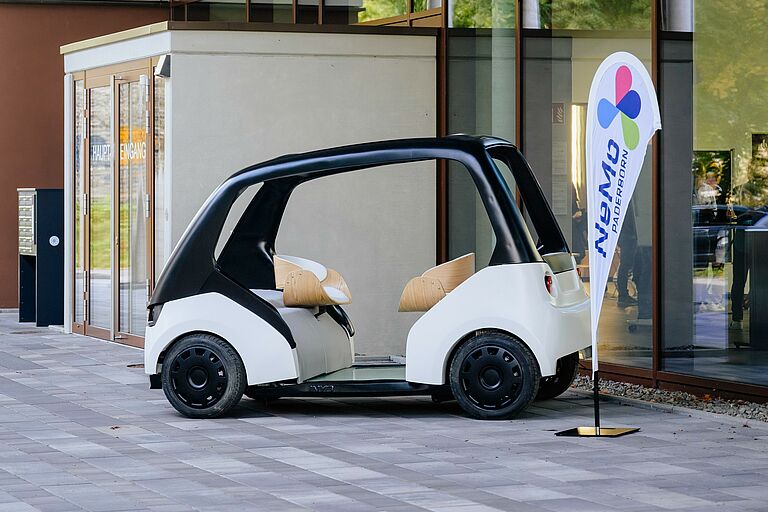
In contrast to conventional solutions, New Mobility takes a systemic approach. Smaller automated vehicles (Cabs), which cover the first and last few miles, join together on longer routes to form a convoy, which is pulled by a larger automated vehicle (Pro). The Cabs will weigh a maximum of 450 kilograms plus battery and offer space for up to four people. The Pros serve as mobile charging stations and enable longer ranges and speeds in the convoy. By combining the two vehicles, the overall system achieves a previously unattainable level of energy efficiency.
The aim of the NeMo.bil project is to implement an innovative mobility approach that brings about significant improvements in the areas of user acceptance, costs, use of resources and emissions. The central components are compact, electrified and very light vehicles that provide needs-based transportation services. NeMo.bil vehicles will enhance the existing public transport system and increase its attractiveness. The system enables individual public mobility that will be as convenient as using your own car.
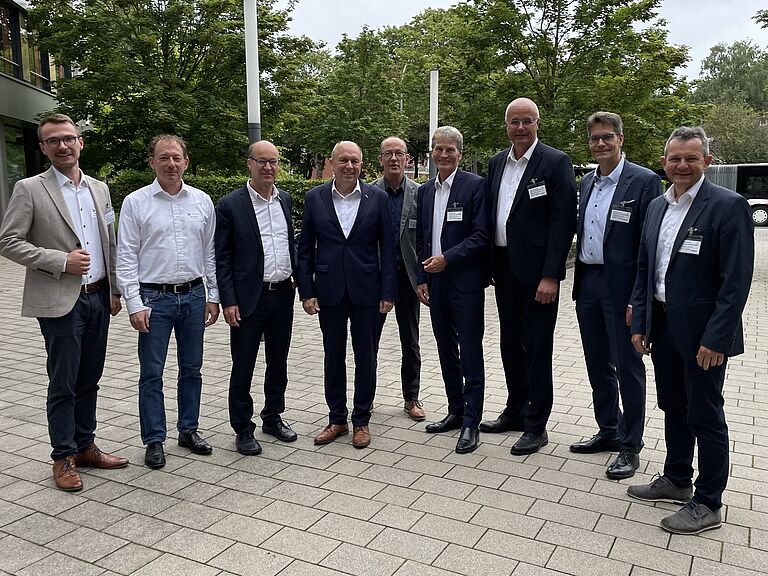
The project consortium comprises 20 partners from industry and science. Start-ups, SMEs and large companies from a wide range of sectors are working together with scientific institutions to achieve this ambitious goal. The success of the implementation is linked to two core innovations: the development of a user-centered, open control and operating platform and the adaptation of automated vehicles to system requirements. This will strengthen the innovative power and future viability of German industry, with a particular focus on small and medium-sized enterprises.
Sustainable transportation systems in rural areas
Paderborn University, with its three participating institutions, the Chairs of Power Electronics and Electrical Drive Technology (LEA) and Lightweight Automotive Engineering (LiA) as well as the SICP - Software Innovation Campus Paderborn, plays a central role in the project. It is actively involved in the overall coordination of the joint project in cooperation with the consortium leader, Inyo Mobility GmbH, thus ensuring the overall progress of the project. Furthermore, the participating areas are researching and developing system solutions in the field of sustainable and highly efficient vehicle structure, charging and drive technologies as well as the data-driven control and regulation algorithm of the autonomous and networked mobility system within their specialist domains.
"We are very pleased about the extensive support from the federal government, which is sending a clear signal for sustainable transport systems in rural areas with its funding. The Hochstift Paderborn region is ideally suited for the pilot project because the state-wide problems in the field of mobility meet an innovative industrial and research landscape that is eager to put the ambitious goals on the road," emphasize project initiator Prof. Dr. Thomas Tröster from the Institute for Lightweight Construction with Hybrid Systems (ILH) at the University of Paderborn and Dr. Thorsten Marten, coordinator of the NeMo.bil project from the Chair of Lightweight Automotive Design (LiA) at the University of Paderborn.
20 partners involved
The following 20 partners form the consortium for the implementation of the NeMo.bil project: Aspens GmbH, Avanco Composites GmbH, Brummelte und Lienen Werkzeugbau GmbH, CADFEM Germany GmbH, CP Tech GmbH, Deutsches Zentrum für Luft- und Raumfahrt e.V. (DLR), dSpace GmbH, FIWARE Foundation e.V., Holon GmbH, INYO Mobility GmbH, LIA GmbH, Neue Mobilität Paderborn e.V., PHOENIX CONTACT E-Mobility GmbH, Poppe + Potthoff GmbH, Reisewitz GmbH & Co. KG, Augsburg University of Applied Sciences, Ostwestfalen-Lippe University of Applied Sciences, Paderborn University, Berlin Science Center and Dortmund University of Technology.