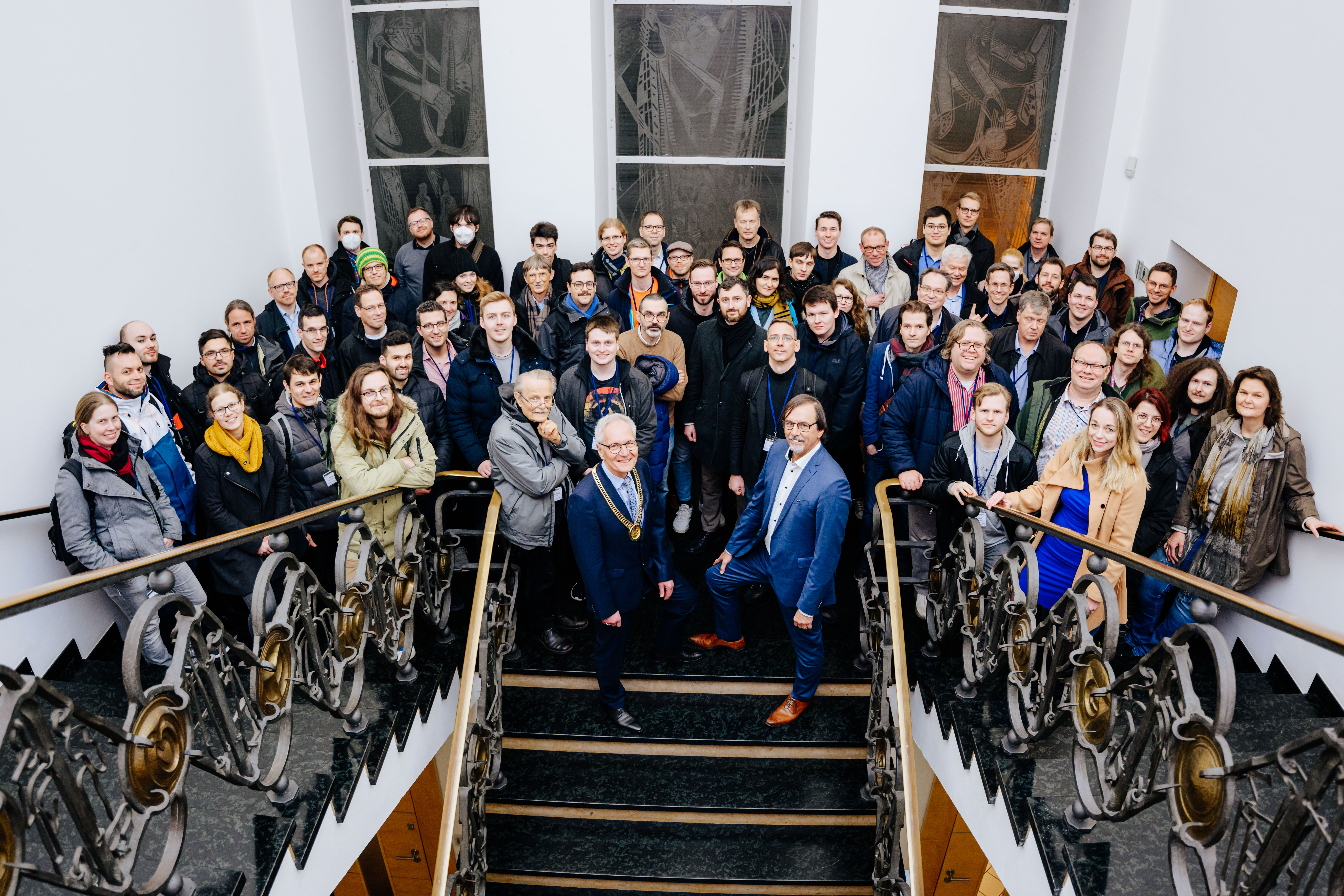
The Software Engineering (SE) symposium of the Software Engineering department of the Gesellschaft für Informatik e.V. (GI) took place in Paderborn this year. From February 20 to 24, a good 200 scientists and software developers from the field came to the Zukunftsmeile 2 research and innovation campus and the Heinz Nixdorf MuseumsForum to exchange ideas and make contacts. The conference was organized by the SICP - Software Innovation Campus Paderborn of Paderborn University under the direction of Prof. Dr. Gregor Engels, professor at Paderborn University and Chairman of the SI-Lab at the SICP.
"At this year's symposium, both the latest scientific findings and industrial experience were exchanged on a variety of topics relating to the development and operation of software systems. The conference is aimed at software developers from industry as well as researchers from academia. The aim of the established series is to bring together and strengthen software engineering in German-speaking countries," explains Prof. Dr. Engels.
Software engineering as a cross-sectional discipline
The main scientific program of SE23 consisted of presentations on previously published articles in international journals or conferences. This offered a "best of", so to speak, of the publications of the research groups in German-speaking countries. "It is clear that computer science, and software engineering in particular, is a scientific field that affects all other scientific disciplines like a cross-sectional discipline.
Software systems that must be of a high quality are used in all areas of our daily lives. This applies, for example, to software in the field of new mobility, intelligent energy distribution, computer-aided medicine, social media or even in new areas of application such as quantum computing," says Prof. Dr. Ralf Reussner from KIT in Karlsruhe and spokesperson for the GI's Software Engineering department. Such systems must be developed and operated using structured engineering methods in order to guarantee quality features such as security, robustness and resource efficiency.
High speed of innovation requires lifelong learning
In order to combat the ever-increasing shortage of skilled workers, new approaches are needed to use university teaching in the sense of lifelong learning. Under the moderation of Prof. Dr. Gregor Engels, Prof. Dr. Wilhelm Hasselbring from the University of Kiel, Dr. Ralf S. Engelschall from msg Research/msg systems AG, Prof. Dr. Andreas Both from DATEV and Prof. Dr. Stefan Wagner from the University of Stuttgart discussed the topic "Upskilling - Reskilling! A task for industry and/or university!" Prof. Dr. Wilhelm Hasselbring put the topic in a nutshell: "The high speed of innovation requires that, on the one hand, employees in industry can always keep up to date with the latest developments and, on the other hand, that specialists with a non-IT degree also acquire the necessary IT knowledge. This is currently being discussed under the terms upskilling and reskilling and may mean that the teaching remit of universities will have to be much broader in the future."
Universities need transfer facilities
Success in industry depends on companies constantly developing further and introducing the latest innovations within the company. In order to support this transfer from science to industry, transfer facilities must be developed and maintained at universities. Various transfer approaches were discussed at the conference. In particular, the campus concept of industry and science working under one roof, which has been pursued at the SICP for many years, was discussed and recognized as forward-looking.
Ernst Denert Software Engineering Award
The main program of the conference included keynotes by Prof. Dr. Ina Schaefer, Professor of Software Engineering at the Karlsruhe Institute of Technology (KIT), entitled "Quantum Software Engineering - Quo Vadis?" and Prof. Dr. Alexander Serebrenik from Eindhoven University of Technology on the topic of "Diversity and Inclusion in Software Engineering". Prof. Dr. Stefan Wagner, Professor of Empirical Software Engineering at the Institute for Software Engineering at the University of Stuttgart, spoke in the third keynote of the week on the topic of "Software engineering training for students and industry". A Student Research Competition was held for the first time as part of SE23. The aim was to give young, budding scientists the opportunity to present their results at a conference at an early stage and to establish contacts with other scientists from German-speaking countries. The conference program was rounded off by a wide-ranging industry program, workshops and the awarding of the Ernst Denert Software Engineering Prize to Dr. Jannik Fischbach, research associate at fortiss in Munich, for his doctoral thesis at the University of Cologne entitled "Why and How to Extract Conditional Statements from Natural Language Requirements". SEUH 2023 on software engineering in the university classroom and deRSE23, the conference for research software engineering in Germany, took place in Paderborn following SE23.