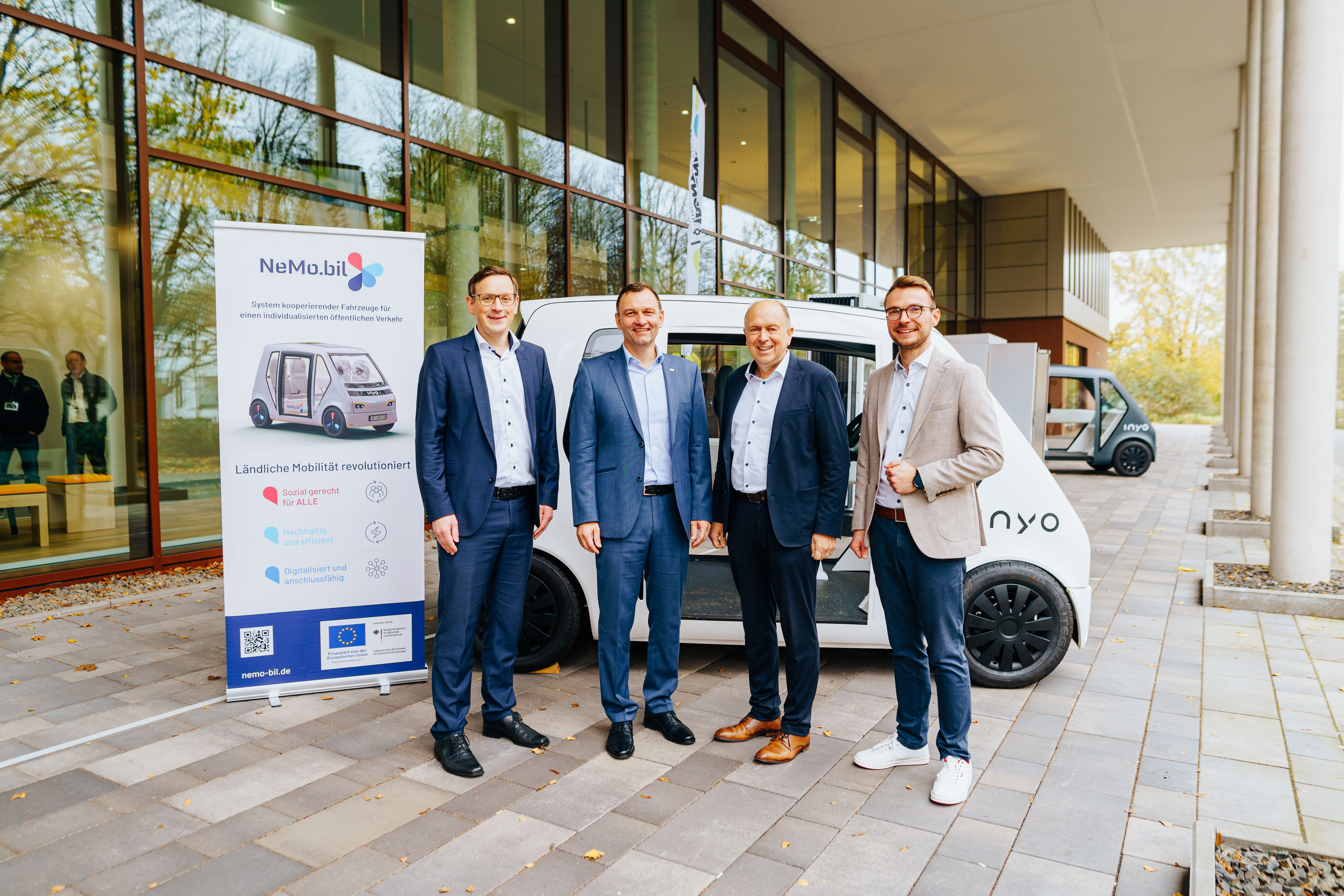
Innovative and networked solutions for the future of mobility in rural areas were the focus of the symposium organised by the transformation hub DiSerHub and Neue Mobilität Paderborn e.V. (NeMo). Around 150 experts from business, science and local authorities discussed the current challenges for mobility between urban and rural areas resulting from demographic and technological change.
"In order to drive forward the mobility transition, various players, topics and aspects must be interlinked," emphasised NeMo Managing Director Jonathan Behm. The symposium focused on a holistic view of future mobility - from innovative mobility services and energy-efficient technologies to digital networking and socio-scientific needs analyses.
After the welcome address by Dr Christoph Weskamp (Software Innovation Campus Paderborn, SICP) and Behm, the focus shifted to presentations and discussions. The District Administrator of Paderborn and Chairman of the Paderborn/Höxter Local Transport Association (nph), Christoph Rüther, emphasised: "We are restructuring local public transport in order to reconcile low population densities, social participation and sustainability. With new approaches and solutions for individualised transport, such as the "Holibri" on-demand service, the nph wants to align transport more closely with demand and tap into new customers.
Prof Dr Thomas Tröster presented another innovative approach. The federally funded "NeMo.bil" project, which recently won the German Mobility Award, is developing an automated on-demand mobility system. "Automated driving opens up new possibilities. Our system offers the same advantages as a private car, but is much more energy-efficient," said Tröster. Jann-Eve Stavesand (dSPACE) and Jonas Wigger (MOIA ridepooling service), among others, shed light on the challenges posed by automated driving.
Digital infrastructure and new business models also took centre stage. Prof Dr Achim Rettberg and Ulrich Ahle explained how the GAIA-X initiative can be used as the basis for data-driven applications in connected vehicles. In the future, digital services will play a more important role than powerful engines. "Connected vehicles provide manufacturers and service providers with valuable insights to improve offerings and develop new business models," emphasised SICP Chairman Prof. Dr. Daniel Beverungen.
Weskamp summarised the successful event as follows: "We have collected many different pieces of the puzzle over these two days. Now we will put them together and put them on the road".