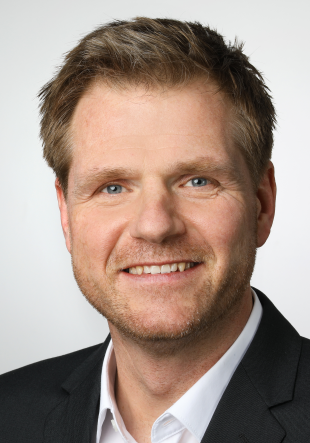
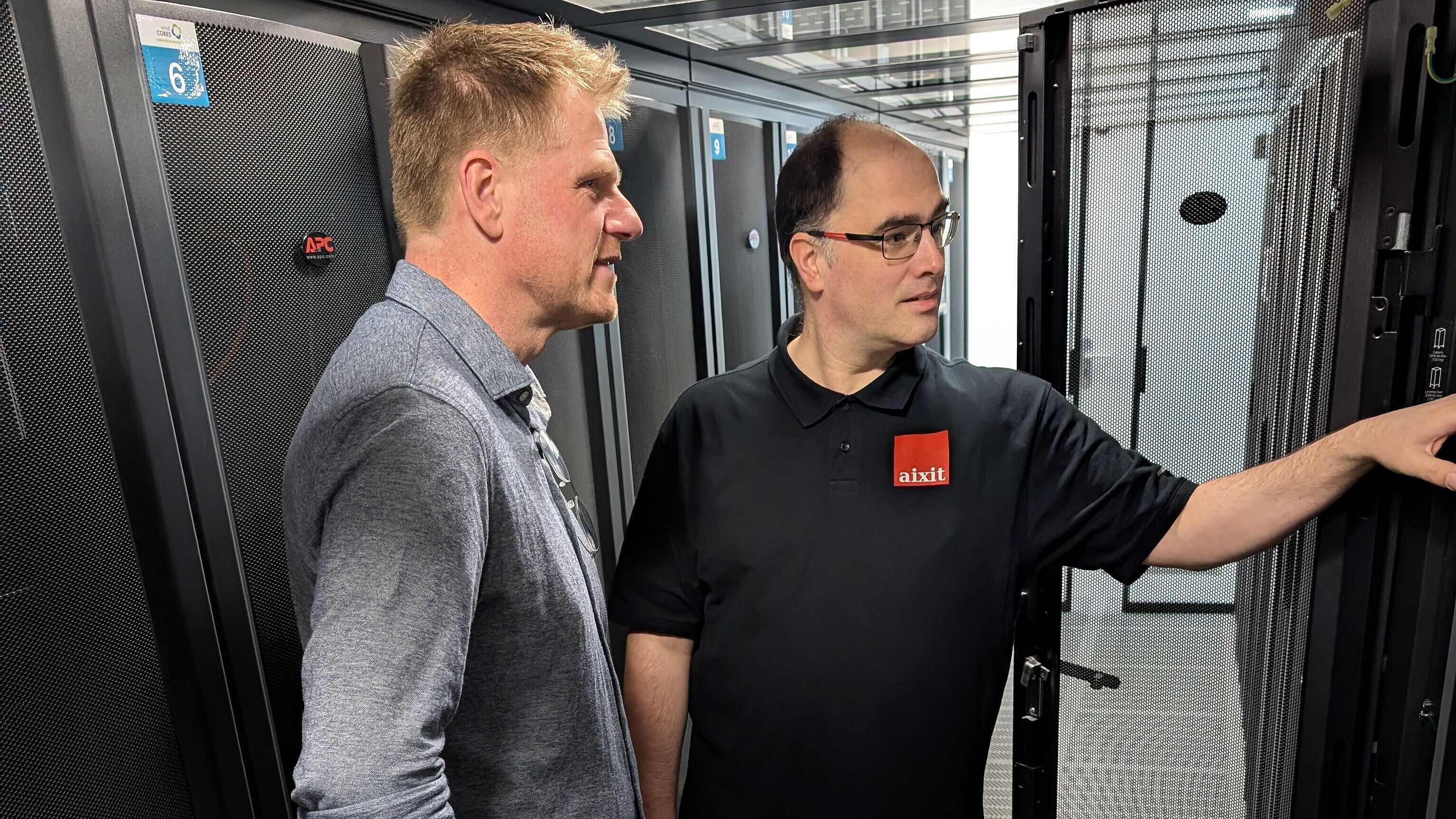
On behalf of DataCenter-insider, author Harald Lutz spoke to Gunnar Schomaker, Deputy Director and Managing Director of the Software Innovation Lab (SI-LAB) at Paderborn University's Software Innovation Campus Paderborn (SICP).
Alongside Frithjof Dubberke, you have made a name for yourself in the industry as the driving force and "mastermind" of the Windcores project. Can you start by recalling the SICP and the SI-LAB at Paderborn University?
Gunnar Schomaker: Before I talk about the SICP, I would like to take a brief look back: The technological foundations for the idea for Windcores were developed far earlier than my involvement in the Software Innovation Campus Paderborn (SICP) and Windcores. Many people played a key role in developing the concept and the market-ready on offer. It was a great team effort right from the start. Even before the energy transition, the first concepts for decentralised, distributed data centres were developed in the "AC4DC" project at the Oldenburg Research Institute for Information Systems. (see also: "Rittal uses the results of the AC4DC project It's all about optimum load distribution in data centres") Together with partners Rittal and the Borderstep Institute, the main focus was on virtualisation, IT load shifting and the potential for greater sustainability.
The question posed by Frank Koch (formerly of Microsoft) provided a key impetus in the direction of energy sources: Why are data centres behaving like the heavy metal industry? It is much easier to go to where the energy is generated and to lay the communication paths accordingly than the other way round.
Gunnar Schomaker:Paderborn University recognised early on that research and industrial practice need to be closely interlinked and organised not just on a project basis, but on a permanent basis. This has resulted in a comprehensive cooperation programme with the label SICP - Software Innovation Campus Paderborn. Thanks to Paderborn University, we were able to set up a campus model with the help of a suitable building in order to work together with our industry partners under one roof. The scientific core of the whole is the SI-LAB as the central scientific facility of Paderborn University. Here, scientists from different departments and chairs work together with the various industrial partners - in a transdisciplinary and multidisciplinary way.
Can you give us an example?
Gunnar Schomaker: Let's take our Artificial Intelligence area of expertise. At first glance, AI appears to be a classic computer science topic. In practice, however, AI is much more broadly based: In addition to Computer Scientists, we also involve cultural scientists, for example, who deal with issues relating to acceptance and impact, or sports medicine when it comes to analysis or training models. This interdisziplinär approach opens up completely different system boundaries and perspectives for us. This is because we do not look at topics in isolation from one specialised discipline, but in the respective application context. This is exactly what makes it so exciting, because it gives rise to innovative questions and solutions.
What part do the co-operation partners from industry play in the Paderborn model?
Gunnar Schomaker: It is particularly important to emphasise that the participating companies are not just seen as transfer recipients to whom we "impart" scientific knowledge. Instead, they actively contribute their own expertise and thus their specific domain knowledge to the joint research. This means that our co-operation partners play a key role in the joint scientific projects. Science and industry develop the findings together. This approach is undoubtedly more complex than others, but we are firmly convinced that it is more closely aligned with concrete benefits than conventional research in the proverbial ivory tower. We also work with companies on a bilateral basis. It is perfectly acceptable for two companies to initially work on an issue on their own and only involve us at a later stage.
Cooling AI data centres
Gunnar Schomaker: If you talk to the large co-location operators today, it quickly becomes clear that a rethink has taken place in terms of cooling. Just two to three years ago, liquid cooling was still not very common in the classic enterprise co-location environment. Back then, industrial applications ran reliably and with high availability using smaller rack densities of up to 10 kW.
With the triumph of artificial intelligence, the co-location sector is now faced with far greater tasks in order to cool between 1 and 50 megawatts of electrical power consumption and dissipate the corresponding waste heat. Can these enormous power densities in AI data centres still be managed at all with conventional air cooling?
Gunnar Schomaker: First of all, the order of magnitude should be properly categorised. I personally don't yet know of any systems that exceed one gigawatt as campus buildings or hyperscalers. If you look at classic co-location data centres, they are in the one to two-digit megawatt range. It is therefore important to differentiate exactly what these power density figures and cooling requirements refer to: the height unit, a single rack, possibly entire rows of cabinets, etc.? I see the increasing heterogeneity of power consumption and cooling requirements as a major challenge. Traditional co-location data centres are designed for relatively homogeneous profiles. AI workloads change this picture considerably. Let me illustrate this with a car park example: The operators of a multi-storey car park have to ensure that the parking spaces match the common vehicle types. This is exactly what the car park is optimised for. If all these vehicles are now minimally small or maximally large and have to be accommodated, the entire system no longer fits and the planning reaches its limits. Co-location data centres are facing the same dilemma today.
What does the transfer of the example look like?
Gunnar Schomaker: With the growing shift of AI workloads to data centres, both for training and inference, two main operating models are conceivable. In the first case, the provider itself provides AI infrastructure as a service. Customers then purchase training or inference capacities in the same way as storage or compute. Inference in particular is probably more suitable here, as it can run permanently and be operated close to applications. In the second case, the customer brings their own AI hardware to the co-location data centre and uses the provider as usual for power, cooling, network and physical security. Inference would then run locally on the provider's hardware, while very energy- and performance-intensive training would be carried out in specialised environments, such as hyperscalers or dedicated high-performance data centres. I think this makes the influence of functional separation clear: inference tends to be closer to the application and co-location, while training tends to take place in specially designed high-performance infrastructures. The standardised, established direction does not yet exist. And my feeling is that high energy requirements will be optimised in terms of costs.
Around half of all IT investments worldwide are currently made in energy- and cooling-intensive areas. However, AI applications can currently only be hosted and cooled in a small number of highly specialised data centres, known as AI factories. The large co-location providers are clearly not yet equipped for this at their locations in Germany with their traditional business model. Is the increasing spread of AI applications today helping water and liquid cooling to make a major breakthrough from its slumber?
Gunnar Schomaker: This also needs to be viewed in a very differentiated way. I am definitely with you: Transatlantically - or wherever - it is currently very difficult to map this. On the one hand, AI and machine learning processes - computing power-intensive software processes - have created a strong social dependency on the international market when it comes to places of fulfilment. However, this is ultimately a fundamental question in terms of strategic orientation: Where does the required service come from? What happens if the service is no longer available in the desired form? On the other hand, I must emphasise that the topic of AI models is often presented in a very simplified way in the press and in politics. As a result, different variants are not considered in sufficient detail. These include different methodological approaches - such as large-language models - as well as questions about the parallelism and synchronisation of systems and therefore also the required spatial proximity. Unfortunately, there is often a lack of precise differentiation here, although it is technically possible to clearly distinguish between the methods and individual areas of application. Within AI and ML, there are methods that do not require a high degree of parallelism, which in principle requires high performance densities, but in practical application tends to be much lower. Unfortunately, if everything is lumped together, you can only come to very fuzzy conclusions. I therefore do not believe that the core statement of hyperscalers is tenable, as they are the only solution for AI.
How should this differentiation be made?
Gunnar Schomaker: If there is a specific application problem, it is important to first look at the problem and determine which classic solution methods already exist and which alternative methods are available from the field of AI. We then examine what can be gained or lost in each case and what requirements result from this, i.e. how high the parallelism is .... On this basis, appropriate solution approaches can be developed, which we evaluate and test with our possibilities. In Paderborn, we are fortunate to have access to the Centre for Parallel Computing (PC2) as part of the National Supercomputing Alliance. We can place our AI workload there, which of course initially involves pre-industrial applications for research purposes. Realising this on a large scale so that it is also economically viable is another aspect of this. I don't see a compelling need for mega-concentrated, highly scaled environments. Although the trend and temptation is moving in this direction, I am firmly convinced that there are other ways.
Won't Germany, with its mostly international co-location operators, miss out on huge business if they don't quickly adapt their long-standing reluctance to water cooling to the realities of the situation?
Gunnar Schomaker: The current major investments are primarily being driven by the fact that companies currently see AI as a powerful lever for increasing value creation. Otherwise, nobody would invest billions in individual gigawatt data centres. From today's perspective, take a classic investment cycle for such infrastructures, for example 15 years for a wind energy plant, and project this value very sportingly onto a data centre. Take a look into the past and ask yourself the question: 15 years ago, who would have predicted today's status quo, even to a certain extent, and forecast it as the future? And now consider the expected technological developments. If no change were to take place, then we would have an extreme problem. But if there's one thing I've learnt, it's this: the IT system landscape, including the scientific domain, has always managed to at least mitigate any bottlenecks that occur, for example in terms of CPU performance or storage capacity. There is also potential for cooling. There are already approaches to operating AI workloads with other hardware. I can imagine, for example, that the topic of computing with light offers great opportunities to significantly reduce power requirements. There is no loss via electrical line transport. Using 10, 100 or 1000 times less energy than with conventional computing could make a huge difference. Companies such as Nvidia are certainly not investing in silicon photonics for network interconnects or similar for no reason. An impact on other areas would therefore be very promising.
How do you see the further development?
Gunnar Schomaker: We expect a decisive leap in innovation on the hardware side rather than on the software side. Although there is potential on the software side in the digital universe itself, the necessary changes are massive and difficult to implement. On the hardware side, these are much easier, but still difficult enough to realise. To put it simply: we would rather switch to electromobility than explain to drivers how to drive energy-efficiently.