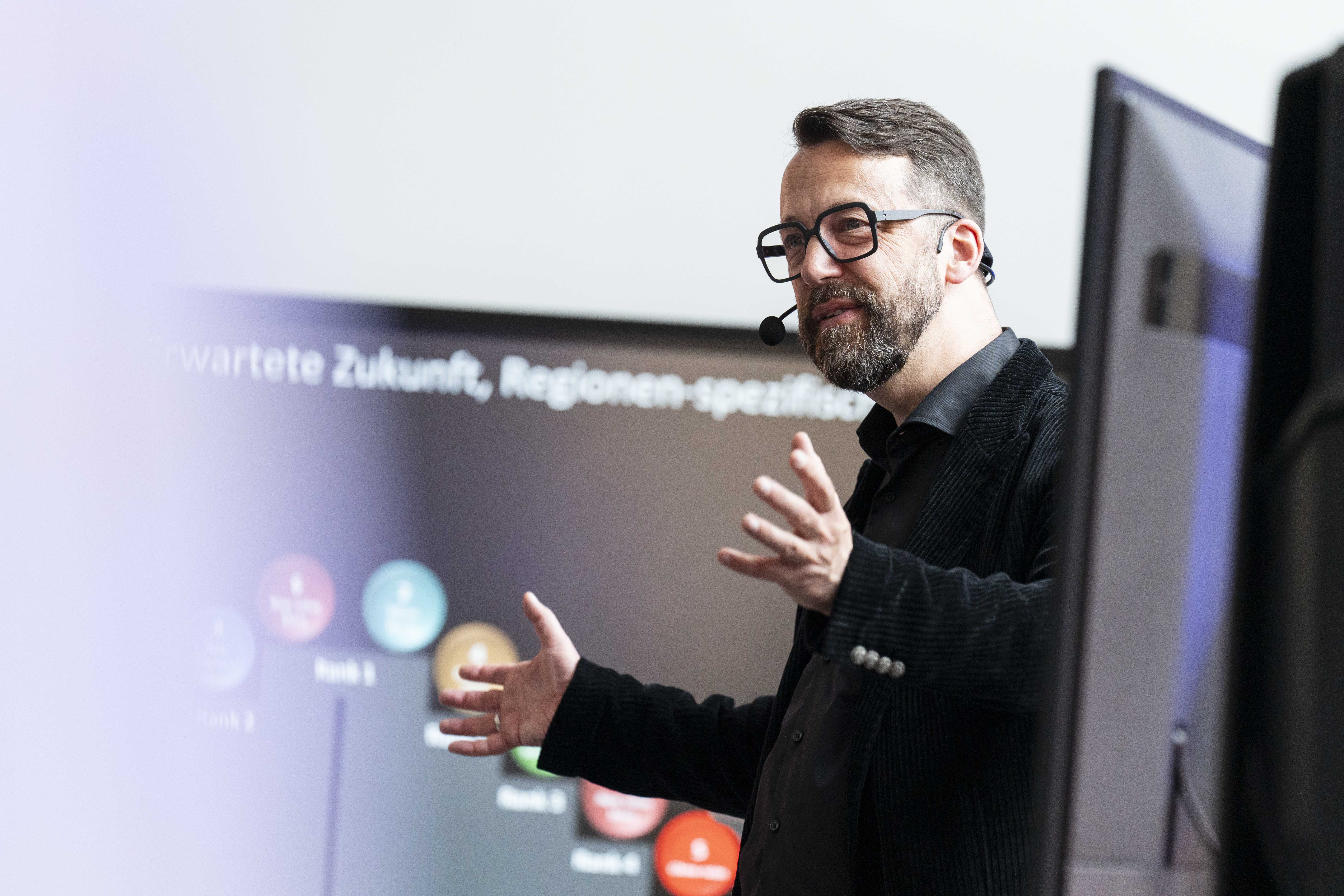
Dr. Alexander Fink spoke about future strategies for companies at the Paderborn IT reception.
Under the title "Uncertain times ahead", Dr. Alexander Fink explained at this year's IT reception organized by the Paderborn Economic Development Agency and the SICP - Software Innovation Campus Paderborn how companies can use future scenarios to think beyond current crises and make more robust decisions. The event took place in Zukunftsmeile 2 and was supported by Verbundvolksbank OWL.
Dr. Alexander Fink, founder and CEO of ScMI AG (Scenario Management International AG), emphasized how important it is to think about the future without wanting to predict it exactly. Since 1998, his company has been supporting organizations and companies in tapping into knowledge about the future and developing targeted scenarios. These scenarios help to derive strategies and business models and drive innovation and change processes.
In front of around 100 entrepreneurs, Dr. Fink advocated "open-minded thinking" and leaving the beaten track. Scenario management, which ScMI AG has been offering for many years, makes it possible to understand and utilize complex interrelationships. Its clients include many German DAX companies, innovative market leaders and public institutions in Germany and abroad.
The scenarios developed describe possible futures that are based on the linking of relevant key factors and span a future space. Dr. Fink explained that a scenario is neither a forecast nor a strategy or a product, but a "thinking tool" that can anticipate possible developments at an early stage. Similar to a weather forecast, scenarios describe "possible framework conditions for our actions".
In his presentation, Dr. Fink provided insights into current projects. For example, he highlighted the effects of an existential crisis in the automotive industry and the increasing use of virtual learning spaces by teachers and students. He also presented a Paderborn study conducted by ScMI AG on behalf of the Archdiocese of Paderborn. This study examines what happens when the church sees itself as an open player in the middle of society.
Dr. Fink emphasized that the first step in all processes is to create market environment scenarios. These scenarios are then combined with strategic considerations in a future matrix to make strategic decisions. "Especially in times of crisis, it is necessary to know positive images of the future and to incorporate these into communication and decisions," Dr. Fink encouraged.
In addition to the keynote speech, the event offered a platform for networking and exchange. Entrepreneurs and decision-makers from business and science were invited. Interested parties who wanted to actively engage with the challenges and opportunities of the future also took part. Due to the lively discussion and the positive response, the WFG and SICP draw a positive conclusion from the event and look forward to the next Paderborn IT reception in 2025.