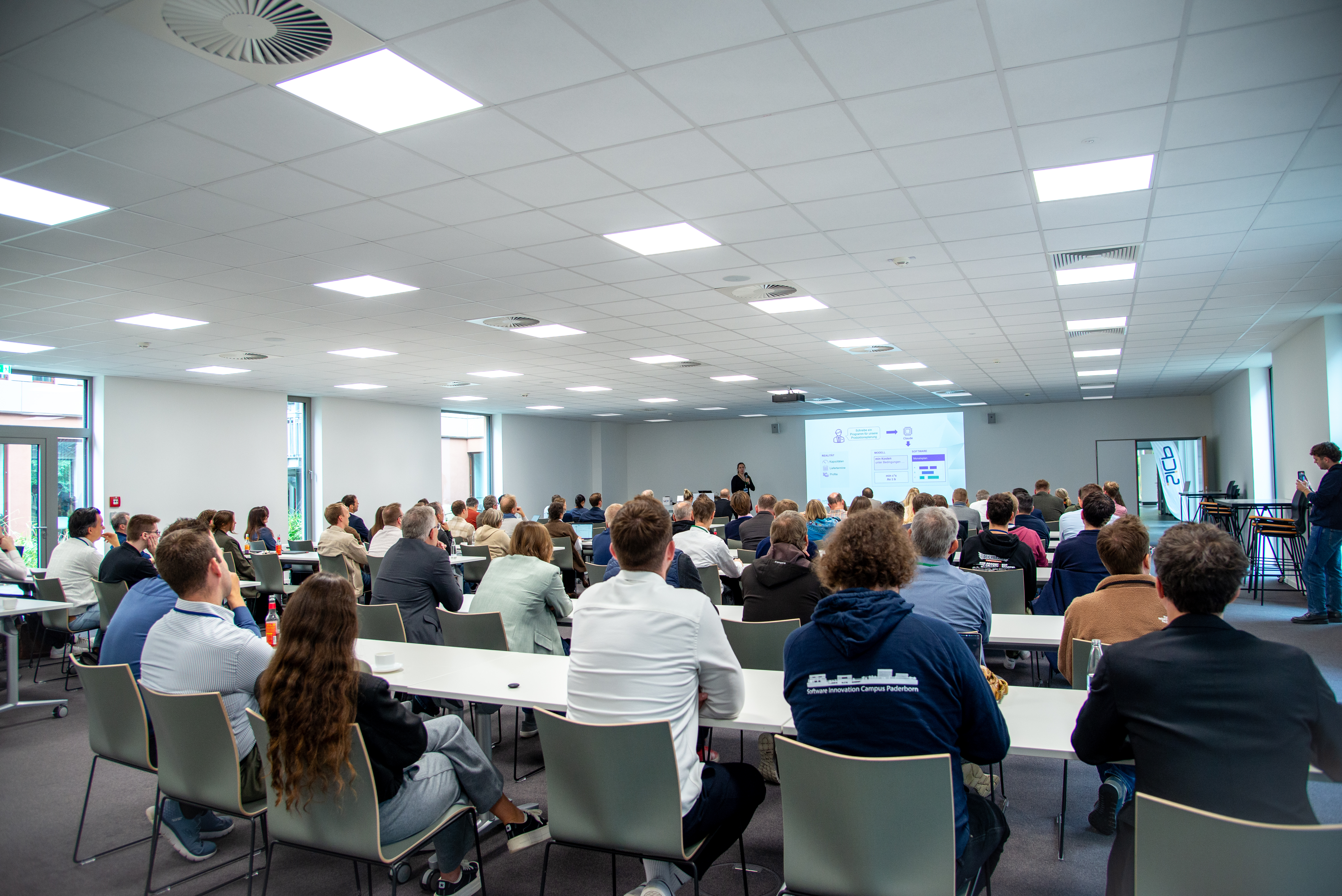
What does a company look like in which artificial intelligence no longer merely supports individual tasks, but fundamentally shapes business processes, decision-making structures and business models? This was the question addressed at the SICP Symposium on Tuesday 13 October at Zukunftsmeile (research and development cluster located in the Fürstenallee in the city of Paderborn). Under the overarching theme ‘AI-Enabled Company 2030’, experts from academia and industry came together to discuss prospects for the AI-supported corporate organisation of the future.
The symposium hypothetically adopted the perspective of the year 2030 and looked back on the decisive years of transformation. The focus was on the vision of a human-centred, agent-based organisation: in such an organisation, people work alongside AI agents that independently undertake tasks, coordinate processes and prepare decisions. Autonomous systems play a significant part in shaping organisational value creation, whilst human judgement, creativity and responsibility continue to play a central role.
The key question was: What technological, organisational and cultural decisions must companies make today in order to harness the long-term potential of AI for innovation and value creation?
Developing people’s skills and organisations
Following a welcome address by Prof. Dr Daniel Beverungen, spokesperson for the SICP Steering Committee and Chair of the Board of the Software Innovation Lab at Paderborn University, the first panel focused on the organisational prerequisites for AI transformation.
Under the title ‘Transforming companies, upskilling people’, Dr Clara Marie Lüders, Analytics Consultant at OPTANO GmbH, and Dr Miriam Sasse, Lead Consultant at S&N Invent GmbH, examined various aspects of this transformation. Dr Lüders addressed the question of how companies can utilise AI whilst retaining key human skills. Dr Sasse highlighted why the use of AI requires a fundamental rethinking of processes, roles and structures.
The subsequent panel discussion broadened the perspectives to include issues of education, sustainability and digital responsibility. Participants included Prof. Dr Karina Kiepe and Prof. Dr Simon Thanh-Nam Trang from Paderborn University. The discussion was moderated by Prof. Dr Franz Strich, Professor of Business Informatics specialising in Digital Responsibility at Paderborn University, who, like Prof. Dr Kiepe and Prof. Dr Trang, is also active at the SICP.
This highlights a key challenge of the transformation: companies must not only introduce new technologies, but also empower their staff to take on new tasks and responsibilities. Systematic skills development and a corporate culture that facilitates learning and change are essential prerequisites for this.
Taking agent-based AI from experimentation to practical application
The second session focused on how companies can integrate agent-based AI into their core processes beyond individual pilot projects. Under the title ‘Scaling the use of (agent-based) AI in companies’, the session centred on the technical fundamentals and new development approaches.
Prof. Dr. Axel-Cyrille Ngonga Ngomo, professor of Data Science and a member of the Software Innovation Lab at Paderborn University, spoke on ‘Neurosymbolic AI for AI-enabled Companies’. Dr Xenija Neufeld, AI Lead at Accso – Accelerated Solutions GmbH, highlighted the changes in software development brought about by AI in her presentation “AI-native Software Engineering”.
The subsequent panel discussion brought together further expertise from the worlds of research and practice. Prof. Dr Eric Bodden, professor of Secure Software Engineering at Paderborn University and at the SICP, and Director of Fraunhofer IEM, along with Dr. Christian Heinzemann, Senior Consultant and Security Engineer at achelos GmbH, discussed the challenges involved in deploying AI-supported systems. The discussion was moderated by Prof. Dr Stefan Sauer, Professor of Human-Centred Software Engineering at Paderborn University and Managing Director of SICP.
The focus was therefore not only on the possibilities offered by new AI systems, but also on the requirements for software architectures, security and development processes. Companies face the task of developing high-performance applications whilst at the same time creating the framework conditions that enable reliable and sustainable use.
Four Barcamp sessions explored future-oriented questions in greater depth
In the afternoon, a Barcamp featuring four parallel breakout sessions offered the opportunity to explore selected issues in greater depth from different perspectives. The topics ranged from the systematic development of AI skills to the question of which decisions AI agents will be able to take in future.
In the session ‘Systematic AI Skills Development’, participants discussed how companies can make the transition from one-off AI training courses to continuous and strategically embedded skills development. Moderated by Dr Christoph Weskamp, Manager of the SICP’s Artificial Intelligence competence area, the session focused on future skills requirements, suitable learning formats and the question of how the benefits of training measures can be measured in day-to-day working life. Prof. Dr Trang and Prof. Dr Strich contributed academic perspectives; alongside many other participants, Wolfgang Wagner from DATEV eG represented the business sector.
The session ‘The Future of Software Engineering’, moderated by Laura Tölle, examined the implications of AI coding tools and autonomous agents for development processes, software architectures and professional roles. Prof. Dr Bodden, Dr Jan Hendrik Hausmann from S&N Group AG and Dr Timo Klerx from paiqo GmbH discussed with the audience which tasks could be automated in future and which skills will continue to be required in software development.
How AI is changing the world of work, collaboration and responsibility within organisations was the focus of the session ‘Cultural Transformation through AI: Rethinking Work, Roles and Responsibility?’. Moderated by Dr Jörg Papenkordt, the session featured Prof. Dr Martin Schneider from Paderborn University, former head of the SICP’s Empowered Life & Work innovation division, Hanna Rammig from ScMI – Scenario Management International AG and Dr Anna Gehring from UNITY AG examined the implications for employees, leadership and corporate culture. Among other things, the discussion centred on how human responsibility and AI-supported decision-making can be reconciled.
The fourth session, ‘AI Agents in the Workplace: From Co-pilot to Decision-maker?’, focused on the increasing autonomy of AI agents. Moderated by Dr Katharina Brennig, Manager of the Software & Service Systems Engineering competence area at SICP, the discussion involved the Director of the Artificial Intelligence competence area at SICP, Prof. Dr Oliver Müller from Paderborn University, Jens Beier from divis GmbH and Stefan Schukat from dSPACE SE & Co. KG discussed with the participants which tasks AI agents can take on today and in the future, where human control remains necessary, and how responsibility must be regulated in the case of automated decisions.
From a vision of the future to concrete areas of action
The various programme items highlighted the thematic breadth of the journey towards becoming an AI-enabled company. In addition to the technical capabilities of AI systems, employee training, the further development of software engineering and data analytics, and appropriate governance structures play a key role. Companies must also clarify how they can reconcile technological sovereignty, regulatory requirements and the capacity for innovation.
The symposium was brought to a close by Prof. Dr Stefan Sauer, Managing Director of the SICP and the Software Innovation Lab at Paderborn University, and Hanna Rammig, Deputy Spokesperson for the SICP Steering Committee.
Looking back at the present from the year 2030 provided an exciting framework for examining today’s decisions from a long-term perspective. The aim is not to follow every technological trend. Rather, the key is to identify viable fields of application, build new capabilities and integrate AI into the organisation in such a way that it creates economic added value and complements human capabilities.
The SICP Symposium thus highlighted the importance of collaboration between academia and industry in shaping the digital transformation. The Software Innovation Campus Paderborn brings both sectors together to research and further develop new technologies and innovative concepts, and to translate them into business practice.