Digitalisation is essential for a climate-neutral economy: it networks systems, enables intelligent control and helps to use resources efficiently. The SICP - Software Innovation Campus will be presenting concrete solutions at the Hannover Messe from 31 March to 4 April.
The SICP is represented at the joint stand of the state of North Rhine-Westphalia with eight research projects relating to intelligent and sustainable energy systems. "Our goal is to develop efficient solutions for the energy sector and energy-intensive industry," says Dr Gunnar Schomaker, Vice Managing Director at the SICP. To this end, the researchers rely on digital technologies such as artificial intelligence and digital twins to penetrate and optimise complex processes in the energy system. The big goal: saving energy, avoiding waste and minimising CO₂ emissions.
Utilisation of waste heat and renewable energies
One of the SICP's key areas of innovation is the use of waste heat and renewable energies to avoid fossil fuels. In the DC2Heat (Data Centre Heat Recovery with AI-Technologies) project, for example, waste heat from data centres is to be used and made available as an energy source, initially using Frankfurt am Main as an example. The main aim of the project is to simplify the use of waste heat from data centres with the help of artificial intelligence.
Enormous amounts of waste heat are generated not only in data centres, but also in industrial production, which often remains unused. In another project (HeatTransPlan), the SICP is working with cooperation partners to utilise this process heat through heat recovery and heat pumps.
Innovative solutions for the decarbonisation of industrial processes
In addition to waste heat utilisation, the focus is on other technologies, including an intelligent assistance system for the sustainable reduction of greenhouse gas emissions (Climate Bowl). This is intended to help companies analyse sources of emissions in their own production and along the value chain - and derive targeted savings strategies from this. The ESN4NW project (energy-optimised supercomputer networks using wind energy) is researching how high-performance computing can be made more energy-efficient using wind energy. Using distributed HPC computing nodes in the energy system and operational management based on power availability, the project partners are investigating the potential savings.
Bringing research to life: Interactive demonstrator for the energy transition
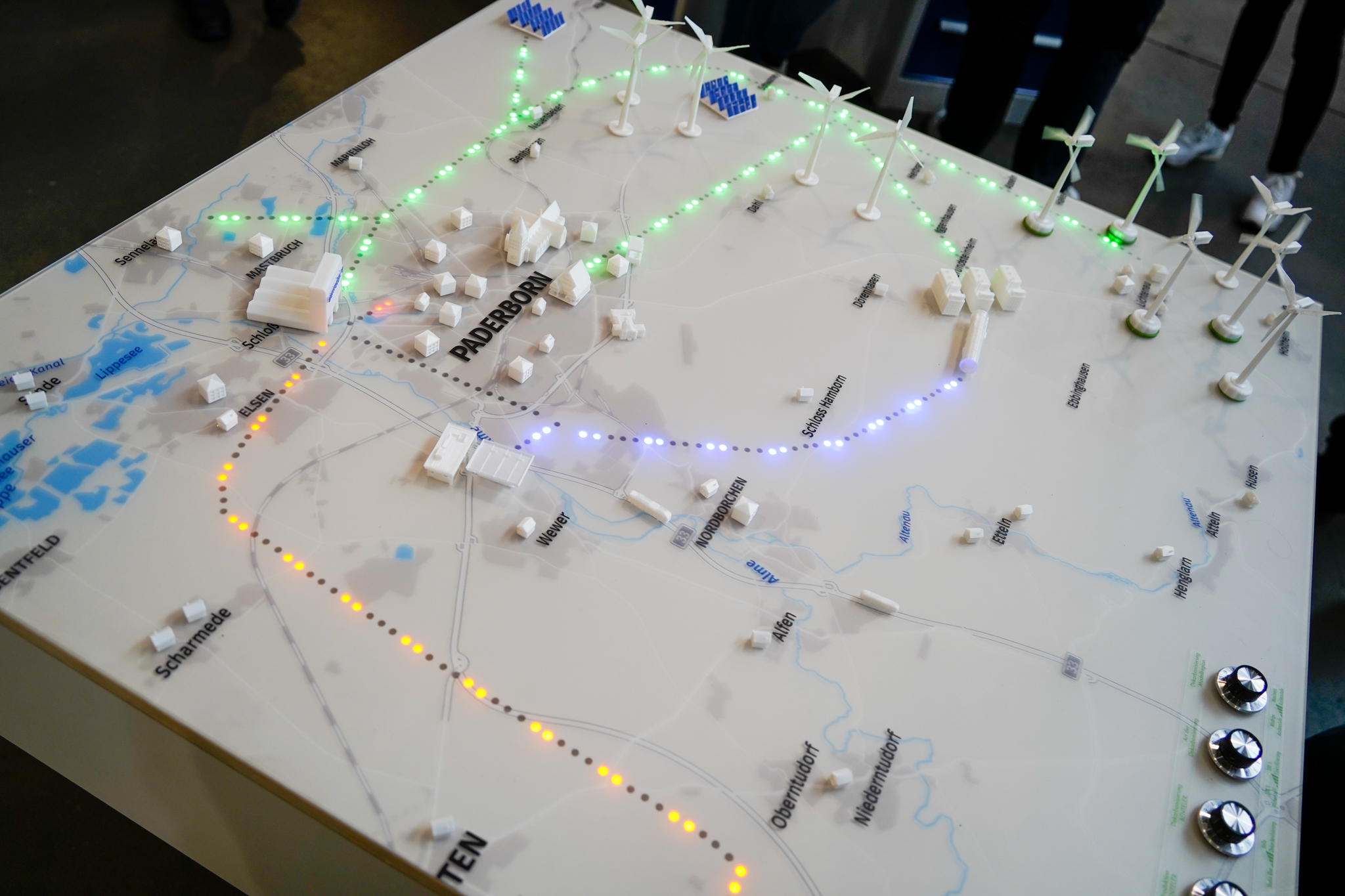
The SICP is using an interactive demonstrator to vividly convey this and other research content to the public at the Hannover Messe. In a miniature model region of the city of Paderborn, renewable energy plants, an electrolyser for the production of green hydrogen, hydrogen filling stations and the company Benteler as a future consumer of hydrogen are modelled. Brightly coloured LEDs simulate the energy flows - green represents electricity, blue shows the flow of hydrogen, red the usable waste heat from production processes and orange the natural gas supply. Various scenarios can be modelled by turning a knob. The changing energy flows show how these affect the energy system. "With this playful and interactive presentation, we make our research tangible and promote an understanding of a holistic energy transition," says Dr Gunnar Schomaker.
SICP invites interested parties to a network meeting at the Hannover Messe
The SICP will be represented at the joint stand of the state of North Rhine-Westphalia in Hall 7, Stand A28 from 31 March to 4 April. A total of 17 exhibitors from industry and research will be presenting innovative energy solutions.
The exhibitors cordially invite you to the network meeting on Monday, 31 March, from 6 p.m. at the joint NRW state stand. Over drinks and finger food, there will be an opportunity for informal discussions and networking with experts from research and industry.
Further information can be found on the trade fair page.
Further information on the projects that will be presented at the SICP stand:
AProSys:https://www.projekt-aprosys.de
DynOpt-San:https://www.dynopt-san.de
Climate bOWL:https://www.climate-bowl.de
HeatTransPlan:https://www.heattransplan.de
Re2Pli:https://www.uni-paderborn.de/forschungsprojekte/re2pli
DC2HEAT:https://dc2heat.de