Specify a destination via an app, be picked up at home a short time later and be taken to your destination in an autonomous vehicle: What sounds like a utopian vision of local public transport for most people in rural areas is the aim of the “NeMo.bil” project. The project partners are developing an innovative on-demand mobility system. To design this and plan its operation, the SICP is working on an intelligent decision support system. What does this look like - and what are the challenges?
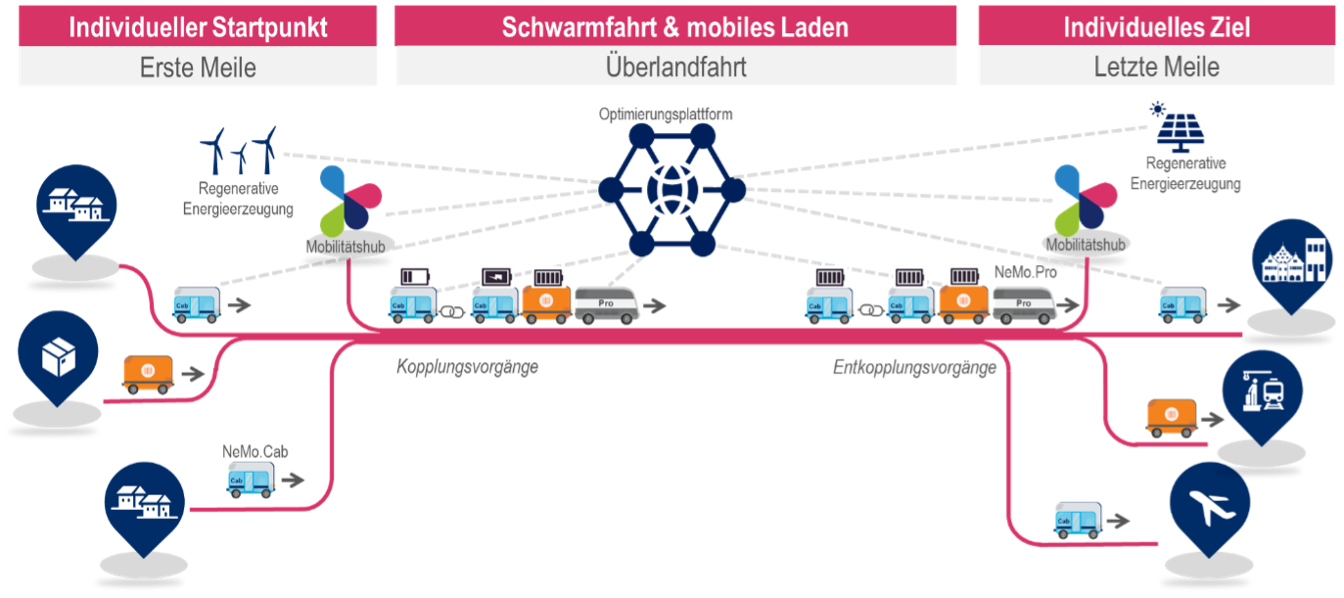
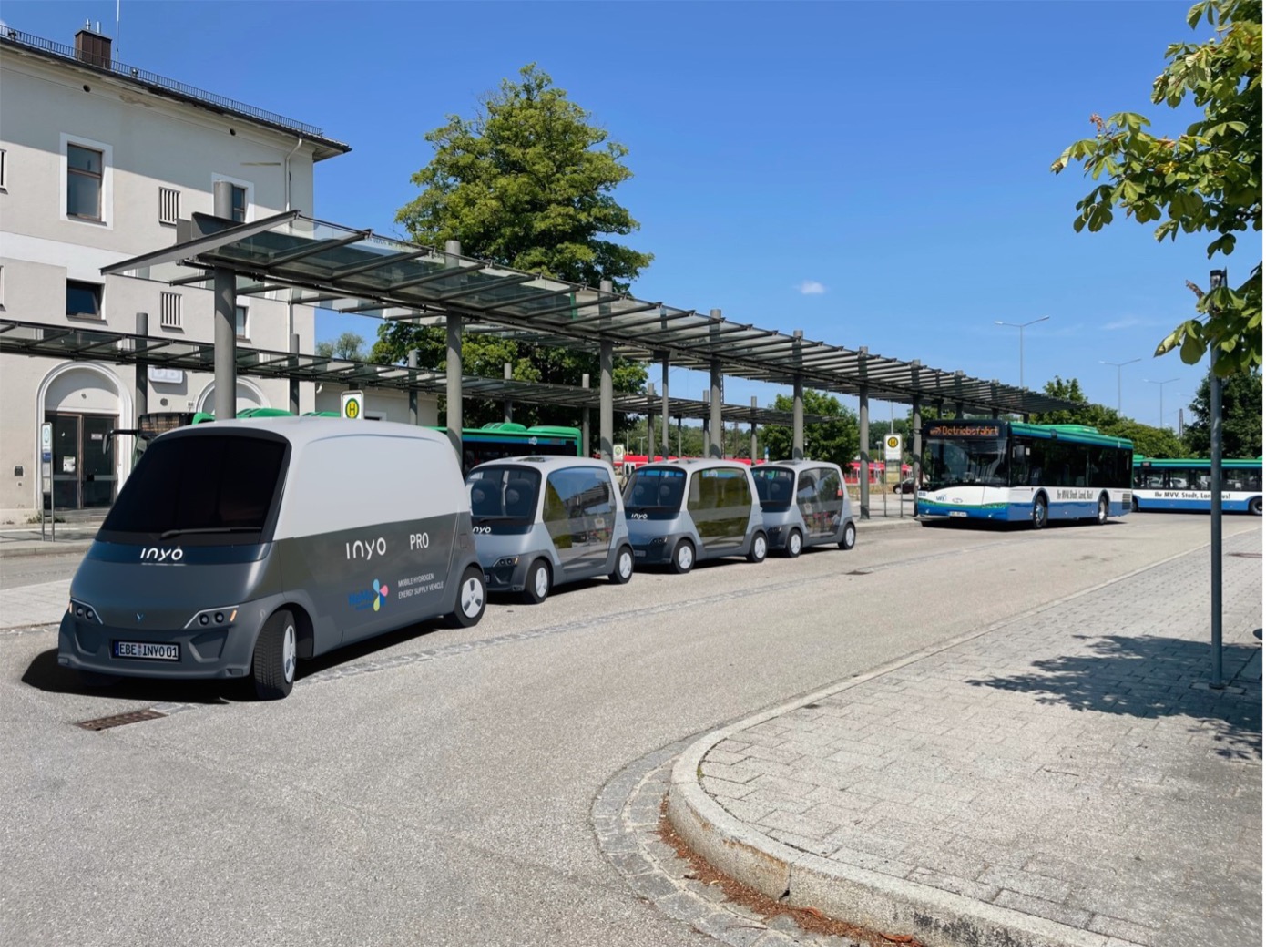
Together with 20 project partners, the NeMo.bil project, funded by the Federal Ministry of Economics and Climate Protection (BMWK) with 17 million euros, aims to establish environmentally friendly individualized public transport (iÖV) in rural areas - ideally as convenient as using your own car. In concrete terms, the swarm system should look like this: Passengers enter their destination via an app and request a so-called “NeMo.Cab”. This small, very light and autonomous electric vehicle picks them up at home and heads for a (virtual) transportation hub. There it joins up with other Cabs coming from other directions to form a convoy. This convoy is pulled by a larger, also autonomously driving vehicle (“NeMo.Pro”). The NeMo.Pro is powered by hydrogen and also serves as a mobile charging station for the cabs, which can be recharged during the coupled journey. In convoy, the small vehicles and the Pro cover longer overland distances and can thus achieve greater ranges and speeds. For the “last mile”, the Cabs uncouple from the convoy again to finally reach their individual destinations.
Planning and designing the on-demand mobility system: smart decisions require intelligent planning processes
The swarm-like mobility system represents a completely new form of on-demand mobility services and therefore offers the potential for cost-efficient and sustainable mobility. In particular, the combination of convoy and individual journeys offers opportunities to strengthen public transport in rural areas. In order to exploit this potential, journeys must be coordinated as far as possible, which requires strategic and operational system planning. This is precisely where the SICP comes in with the project. “The aim is to answer the question of how the swarm-like mobility system with the NeMo.Pro and NeMo.Cab vehicles can be designed and operated as efficiently as possible for different usage scenarios under ecological, economic and user-specific aspects. To this end, an intelligent decision support system is being developed in the project,” explains Dr. Christoph Weskamp, Head of the ‘Seamless Mobility’ innovation area at the SICP.
Strategic fleet planning includes questions about the design of the fleet portfolio. For example, it is necessary to determine how many vehicles of which type are to be purchased for a particular region. Vehicle characteristics such as the number of seats in a Cab and the battery capacity of the vehicles must also be examined. These characteristics provide the framework conditions for operational planning, which ensures the most efficient operation possible and addresses the following questions:
- How can passengers reach their destination as quickly as possible by means of optimal route planning?
- How can different trip requests be bundled and combined into a cost-efficient convoy trip that also means the shortest possible travel and waiting times for passengers and the highest possible utilization of the cabs?
- How can the cabs - depending on their respective routes - be most sensibly arranged in the convoy?
The shortest possible waiting and travel times, the lowest possible costs and the lowest possible environmental impact - is that possible?
“One challenge of strategic fleet planning is the simultaneous consideration of different optimization goals that may be in conflict with each other,” says Professor Guido Schryen from the University of Paderborn, member of the scientific project management team. While passengers want short waiting and travel times, operators need to find a business model that is as viable as possible - in other words, to generate as much revenue as possible from as many transports as possible with the lowest possible operating and investment costs for the vehicles. These criteria can be contradictory: If fewer vehicles are scheduled, this may lead to lower investment costs, but is also likely to result in longer travel times and therefore possibly lower passenger acceptance. “Our task is to weigh up these objectives against each other and find solutions that are as good as possible while taking the target system into account,” explains Professor Schryen.
To do this, the strategic and operational planning problems must be solved in an integrated manner - a major challenge for the design of the complex system: “This means that the short-term real-time planning, i.e. the logic according to which the system reacts to spontaneous transport requests, must be taken into account in the long-term strategic planning,” says Professor Schryen.
Various optimization approaches as the basis for an intelligent decision support system
In order to solve the complex planning problem, various intelligent optimization models and procedures are developed, on the basis of which the decision support system is ultimately created: This supports mobility providers in planning a needs-based mobility system for a specific region. “On the one hand, the planning problem is mapped as a mathematical model that is solved with the help of problem-specific heuristics. On the other hand, a simulation is carried out that does justice to the dynamic decision-making environment of NeMo.bil,” explains Professor Guido Schryen. “This simulation makes it possible to analyze the effects of different decisions on the overall system and thus plan efficient system operation before the decisions are implemented in reality.”
New innovation area at the SICP: Seamless Mobility
Overall, Paderborn University can draw on extensive experience in the field of operations research. In the field of mobility, for example, these include projects on infrastructure planning for electric buses and cab ridesharing systems. The NeMo.bil project is part of the newly founded “Seamless Mobility” innovation area at the SICP, in which socio-technical solutions for the transformation of today's mobility system are being researched in close cooperation between business and science. For example, it is investigating how enabling technologies such as artificial intelligence, digital platforms and data spaces can help to design new, needs-based and sustainable mobility solutions and enable networked mobility solutions. In addition to technical aspects, the behavior and needs of users are also examined. The issues are being addressed in inter- and transdisciplinary collaboration with representatives from business, science and politics. Are you interested in participating in the transformation at the SICP research campus? Please feel free to contact us (Dr. Christoph Weskamp, weskamp@sicp.de).