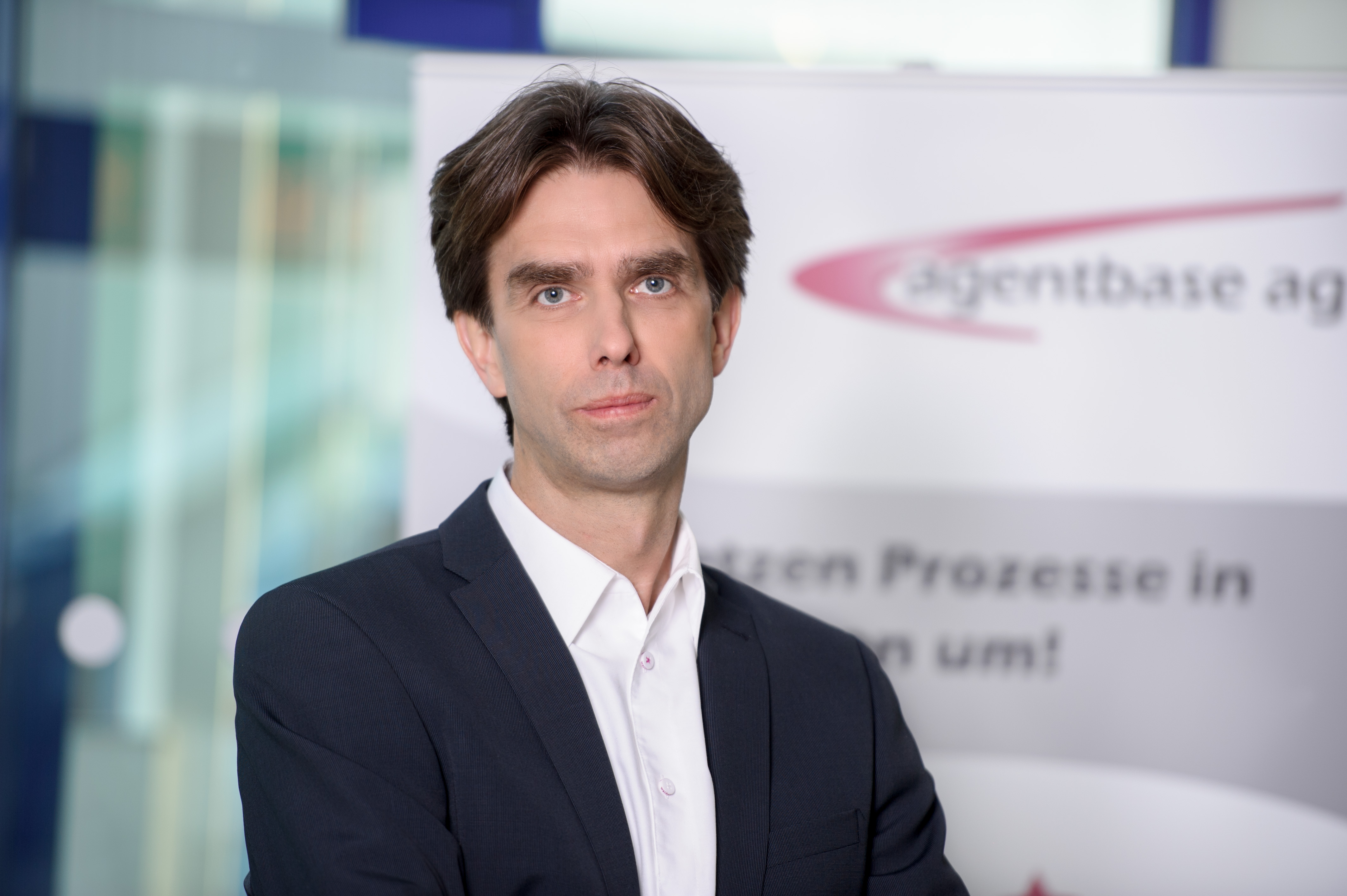
Who is agentbase AG and what characterises the company?
Andreas Forth: First of all: I only use the masculine gender form in my formulations. This is in no way intended to be discriminatory or marginalising. In my view, it merely serves to improve readability.
agentbase AG is a software service provider from Paderborn. As far as software development is concerned, we come from the "Rapid Application Development corner" - in other words, the creation of software solutions for our customers in an agile exchange with our customers. We were already practising agility in software development when the word was not yet so common in software development. It was therefore an obvious step for us to focus on a high-performance and powerful low-code platform that would enable us and our customers to develop business-critical software applications in a very short time and therefore at a manageable cost. We use the OutSystems low-code platform for this purpose. We are a certified partner and the only training provider for this platform in Germany.
We are characterised by the fact that we always develop software solutions together with our customers and also think a little for our customers - sometimes even as early as the requirements description stage. Understanding our customers' business processes and use cases and generating an ideal solution in the software implementation - I think that's one of our team's greatest strengths.
In particular, thinking outside the box is very much appreciated by our customers.
How has agentbase AG developed in recent years and what goals are you pursuing for the future?
Andreas Forth: agentbase AG has grown rapidly and strongly in terms of personnel in recent years. We have almost doubled in size and continue to strive for steady growth, as we recognise that the market in the German-speaking countries for service providers in this field is large and has room for expansion. When we made the strategic decision to rely on OutSystems' low-code platform in 2018, we set ourselves the goal of becoming OutSystems' largest German-speaking partner. If you look at the ranking, which is of course also available for OutSystems partners according to various criteria, then we are on the right track. (Note, I'm not counting the very large international partners, who of course also have an office in Germany ;-)) I would even go so far as to say that we are one of the largest German partners in terms of certified German-speaking consultants.
What are the biggest challenges the company is currently facing?
Andreas Forth: Uncertainty...
To be honest, it's the uncertainty that prevails in the markets and companies. Over the last few years, we've actually gone from uncertainty - I remember corona, then the war in Ukraine, the grand coalition with its major disagreements.... And now the Trump administration in the USA with constantly changing framework conditions for German exports. This is not a situation in which companies are boldly investing in new technologies.
And the topic of AI and AI is relatively new. Many companies are now standing like rabbits in front of a snake and would rather not move at all before they take the wrong step and "get eaten" - although that is no longer entirely true. In my perception, more and more companies are recognising the potential of AI and AI and are starting to deal intensively with these topics. This in turn is good for us because the OutSystems platform has already internalised many AI functionalities and provides customers with a protected space in the software projects to use AI functionalities and the associated power. I could go on and on about this, but that would certainly go beyond the scope of this interview.
You rely on high-performance low-code in your customer projects. What specific advantages does this approach offer your customers compared to traditional development?
Andreas Forth: I'll list a few points, which I'll explain in more detail afterwards:
- Speed
- Reusability
- Relief of developers from routine activities
- Cost reduction
- Contribution of different resources
Speed. We have realised that we are actually many times faster in our projects than if the solutions were developed with high code. And one point is very important to us. We use the low-code platform to make professional developers better and faster. We are not interested in enabling so-called citizen developers to generate complex software applications themselves. That is certainly possible - but it is not our primary aim. In the words of one of our customers in a current project: "We want to see if we can set a new speed record in this project." This is a customer from the logistics sector and we are not talking about a small app here - but about a full-blown application for a customer that is to be implemented in 3 months with a 4-person team. From recording the requirements to going live!
Reusability - Once developed, modules can easily be made available to other developers who can reuse them in their software projects. The graphical modelling of the code makes it much easier for developers to familiarise themselves with the code of another developer and reuse these modules or make the corresponding adaptations themselves.
The platform is highly performant and "intelligent". What does this mean in the development process? It supports the developer in many routine activities and relieves them of some or all of these tasks. This starts with continuous software checks, suggestions for improvement, tips on how other developers have solved a problem, monitoring of security issues, performance checks and, if necessary, suggestions for performance improvement, automatic deployment across the various stages - i.e. from the development environment to the test environment to the production environment, management of access authorisations in the various stages, etc., etc... to conclude with automated documentation.
This inevitably leads to a reduction in costs in the development process. Of course, the low-code platform also costs money - but it also offers a lot in return - not to mention the fact that I can also use it as a cloud solution.
The low-code platform and the low-code approach particularly support the agile approach in software development. It is much quicker to involve the specialist departments and/or stakeholders in the development process.
An example:
A new AI-based module, known as Mentor, makes it possible to use a natural language description of a software project to develop an initial draft, which is already clickable and has various user roles, completely automatically. This can be done within 10 minutes, allowing the consultant and software developer to take a first look at the future solution together with the requesters and discuss directly with the requesters whether the chosen path is in their interest.
What specific challenges do you regularly encounter in your low-code projects and how do you solve them in practice?
Andreas Forth: [... with a smile...] Fear of contact and reservations among high-code developers. Many high-code developers initially place low-code in the "tinkering, painting and toy corner". They simply can't imagine that low-code can be as powerful as high-code. It is a different approach to programming and it takes a certain amount of time to make this different type of programming "palatable" to experienced high-coders. We know this from our own experience with our own employees. But once it has clicked, the learning curve is very steep and the successes in our projects prove us right.
We and our customers are not trapped in the low-code world. Whenever it is absolutely necessary, we can always fall back on high-code elements and modules in the low-code world and use them as a supplement. There are no limits and of course we can also use any type of interface and API with the OutSystems platform.
What makes agentbase AG unique compared to other companies in the industry?
Andreas Forth : Uniqueness is always such a big word. "We're not reinventing the wheel either." But what I do find special is how closely and trustingly we work together with our customers and partners. I find fairness both internally and externally extremely important. I can't imagine that we would work for a customer where the feeling of "we act as equals" is not there.
We are also innovative and fast when it comes to market trends. We have been working on the topic of AI and AI for some time now and have also implemented corresponding components in our projects. We want to be as close as possible to the latest technological developments - incidentally, this is also one of the reasons why we became a member of the SICP.
How would you describe the corporate culture at agentbase AG?
Andreas Forth: Open, cooperative and fair - but also demanding. I think the first three points are self-explanatory - I would like to say a little more about the "demanding" point. I need to expand a little on that.
When we look at the topic of employee recruitment, we realise that there are very few trained OutSystems experts in German-speaking countries. This means that we train all of our new employees ourselves and this phase takes two to three months. So we invest a lot in our new employees in advance. It usually takes 6 to 9 months before they can be deployed productively and billable in customer projects. Even in these first few months, we demand a great deal of initiative from our employees - and this will not change. We need independent doers in our project teams. We give our employees a great deal of freedom - but they have to fulfil and use this freedom sensibly. On the one hand, our employees must constantly develop themselves further, on the other hand they must be curious about new things and also be prepared to take on responsibility without a safety net. This is certainly a challenge at times, but it is also a lot of fun when you realise that you are developing.
What motivated agentbase AG to become a member of the SICP - Software Innovation Campus Paderborn?
Andreas Forth : We have always had very close contact with Paderborn University in the past. In particular, we were very closely networked with the Chair of Information Systems - you could even say that we are actually a spin-off from the university...
Unfortunately, this close contact had been lost somewhat in recent years. We wanted to intensify this contact again and get closer to research in the field of software development. Establishing contact with the SICP made sense - especially as we have known and valued Prof Dr Stefan Sauer for many years.
We think that we can contribute very well to the SICP consortium with the topic of low-code development. Low-code development as we understand it and how we practise it is a new form of software development and the possibilities offered by AI in this environment are far from being fully realised.
At the SICP, we see ourselves as a mediator between theory and practice. We are happy to take up impulses from research and, in return, reflect our practical experience back to research.
Getting new food for thought and looking at other approaches is a great motivator for us to become a member of the SICP.
How do you benefit from membership of the SICP? Are there any specific benefits that you have been able to realise so far?
Andreas Forth: Oh yes, there are quite a few:
We will soon be holding a workshop with Dr Dennis Wolters. The aim is for our employees to get to know their strengths as team players better so that they can work together even better as a team.
My Management Board colleague Thomas Rychlik and I took part in a workshop on Lego Serious Play, which we found very interesting.
We will be taking part in Students Day in May and presenting ourselves as an employer. So the topic of employee recruitment is also relevant for us.
We will then use the premises of Zukunftsmeile 2 for a customer event. This is only possible because we are a member of the SICP.