Paper presented in Cambridge
From 10 to 11 July 2025, an international workshop on sustainable computing systems took place at the Microsoft New England Research and Development Center (NERD) in Cambridge, Massachusetts. The aim of the event was to bring researchers together to share ideas and innovations that contribute to a more sustainable use of end devices, cloud infrastructures, networks and data centres.
Causal machine learning for sustainable data centres
David Zapata and Marcel Meyer, both research assistants in Information Systems, in particular Data Analytics, took part in the workshop and presented their paper "Causal Machine Learning Approaches for Modelling Data Center Heat Recovery: A Physical Testbed Study". The paper was written as part of the DC2HEAT research project and investigates how the operation of data centres - in particular the generation of waste heat - can be modelled using causal machine learning methods.
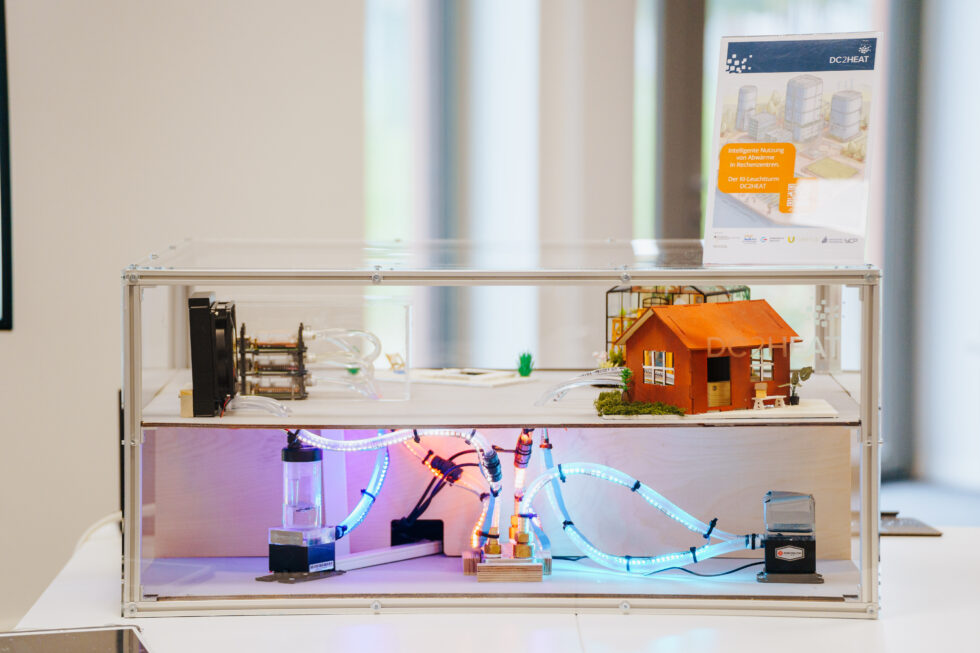
A physical demonstrator serves as the basis for measurement, which was developed to visually and comprehensibly present the mode of action of AI and waste heat utilisation on the one hand and to actively conduct research on the demonstrator on the other. The demonstrator uses the waste heat from Raspberry Pis, which is dissipated using direct liquid cooling - i.e. direct liquid cooling in which components such as processors are circulated - and shows how this can be optimised with the help of a digital twin.
"Our central research question was whether real physical systems can be better modelled with causal methods than with purely data-driven methods. Our results show that the operation can be mapped well using classic data-driven approaches. However, causal methods can offer decisive added value when it comes to evaluating what-if scenarios and controlling systems in a targeted manner. This is of particular interest to researchers in the field of sustainable data centres and operators who want to use waste heat efficiently," explains David Zapata.
Inspiration from the workshop
The workshop made it clear that an active community with a clear focus on reducing emissions is committed to the sustainability of computer systems worldwide.
"It was particularly exciting for us to see that the recovery of waste heat from data centres has so far received less attention outside Europe, but is becoming increasingly important. The variety of topics was also very impressive. It ranged from detailed carbon accounting for the smallest processors to the possibility of operating data centres even in space. The diverse ideas and concepts that were discussed were very inspiring for us and we were able to gather many ideas for our own research," summarises Marcel Meyer.