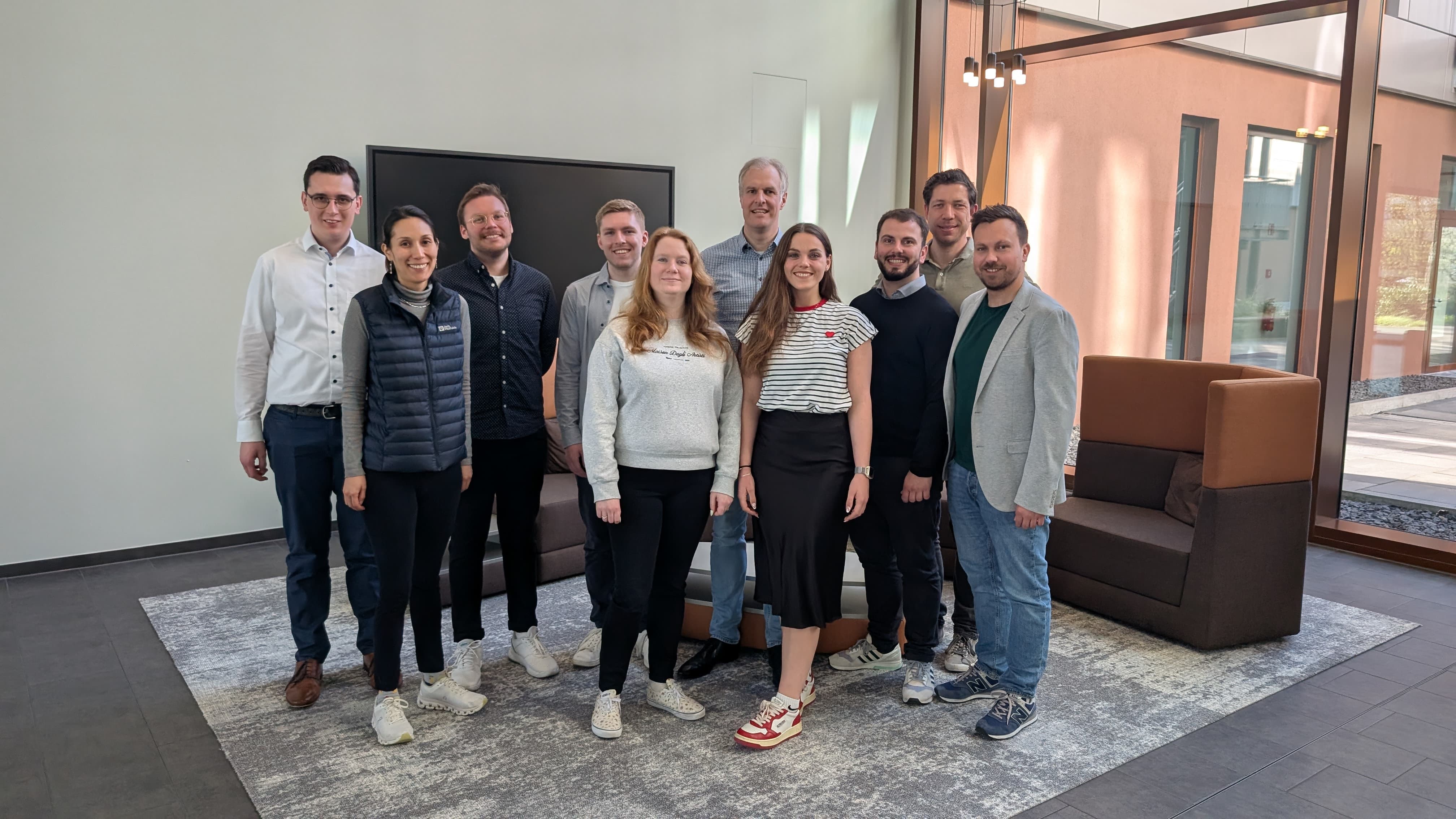
How can methods and infrastructures be designed to effectively implement data-driven service innovations - even in dynamic and complex ecosystems? These and other questions were the focus of the consortium meeting of the SHAPE research project (Design of service development processes and innovation partnerships with companies) on 3 and 4 April 2025 in Paderborn.
Organised by Prof. Dr. Daniel Beverungen, holder of the Chair of Information Systems, in particular Business Information Systems, at Paderborn University, Chairman of the Board of SI-Lab and spokesperson for the SICP steering committee, and Jannika Schäfer, research assistant at the Chair of Information Systems, in particular Business Information Systems, the project team met at Zukunftsmeile 2 in Paderborn to reflect together on the progress of the project and shape the next steps on the way to practical implementation.
Interactive insights, setting the strategic course
The meeting kicked off with an interactive poster session and intensive dialogue: all partner institutions provided exciting insights into their work from the first year of the project. This provided space to discuss the integration of the work packages in a targeted manner.
The contribution of a thematic subgroup, which presented key findings from a qualitative study with 17 small and medium-sized enterprises (SMEs) and public institutions, was particularly interesting. The focus was on the challenges and solutions for orchestrating service innovations in ecosystems.
Building on this, the focus turned to the future: the upcoming "sprints" were discussed - in particular their design, process, resource requirements and the upcoming piloting with practice partners from the local ecosystems. A joint dinner in Paderborn city centre at the end of the first day provided space for further discussions - in a relaxed atmosphere and in the best spring weather.
The second day started with a short wrap-up before the consortium entered into dialogue with Erik Mertens and Yvonne Haußmann from the Karlsruhe project management agency. The focus was on impulses for the further orientation and stabilisation of the project results. The consortium partners then discussed the publication and communication strategy for the current year and launched new joint initiatives in the field of knowledge transfer and dissemination.
On the way into practice
After an intensive phase of conceptual development, the next important step now comes: implementation in practice. SHAPE is now increasingly moving into the piloting phase. In the coming months, selected approaches will be trialled together with practice partners from the respective local ecosystems. This is a crucial step - not only for the evaluation of the work, but also for the subsequent dissemination of the approaches developed.
Who was there?
On site in Paderborn, alongside Prof. Dr Daniel Beverungen and Jannika Schäfer from Paderborn University, were Prof. Dr Gerhard Satzger, Peter Hottum, Daniel Heinz, Jonas Liebschner and Vanessa Robayo Ladino from the Karlsruhe Institute of Technology (KIT), Angela Roth and Matthäus Wilga from Friedrich-Alexander-Universität Erlangen-Nürnberg (FAU), Polina Rajko from the University of Hamburg (UHH), Henrik Cohnen from FIR at RWTH Aachen University and Christian Bartelheimer from the University of Göttingen.
Nina Lugmair (FAU), Prof Dr Tilo Böhmann (UHH) and Regina Schrank(FIR) weredigitally connected.
Find out more about SHAPE?
Click here for the project website: https://www.uni-paderborn.de/projekt/1250