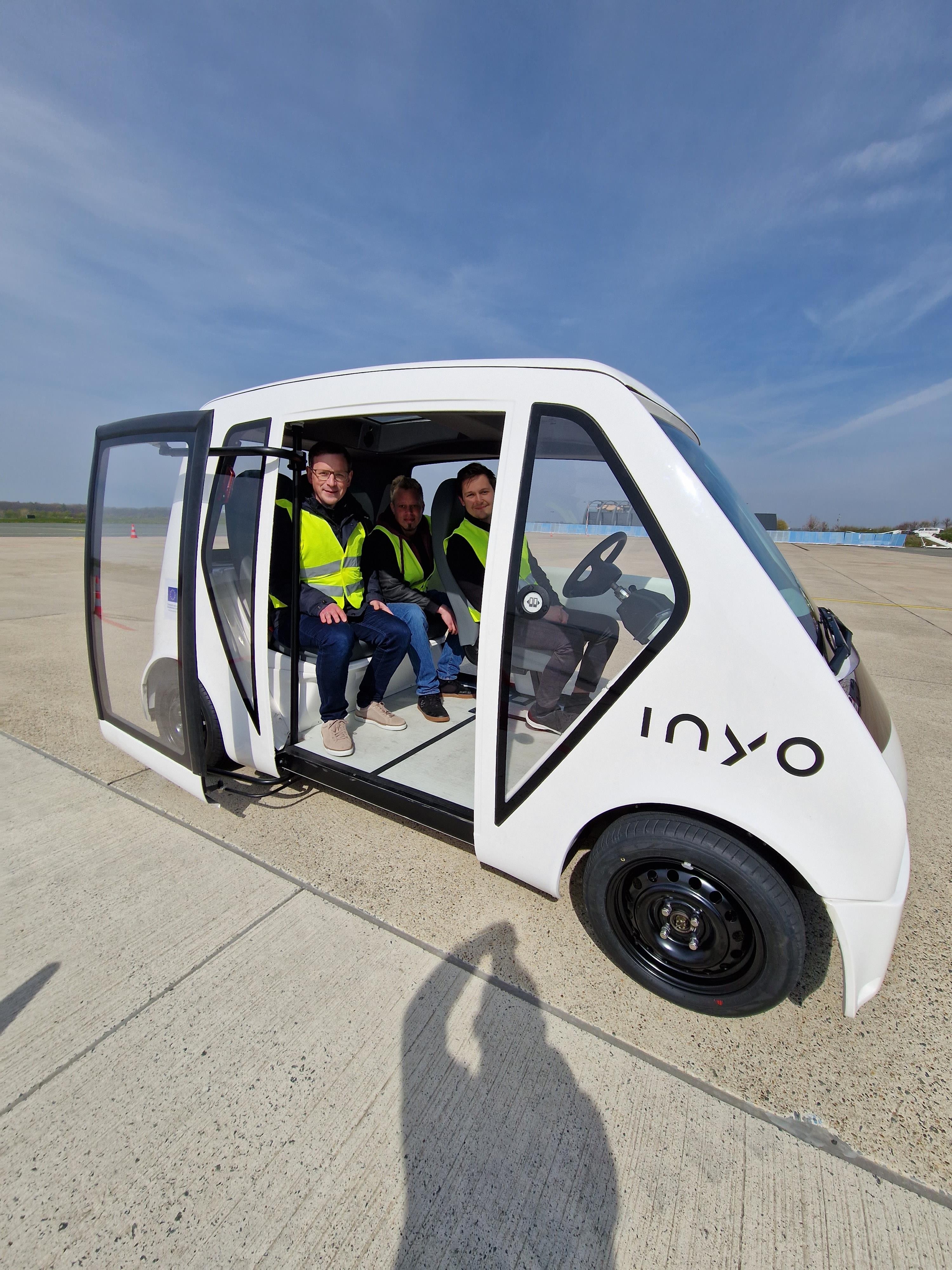
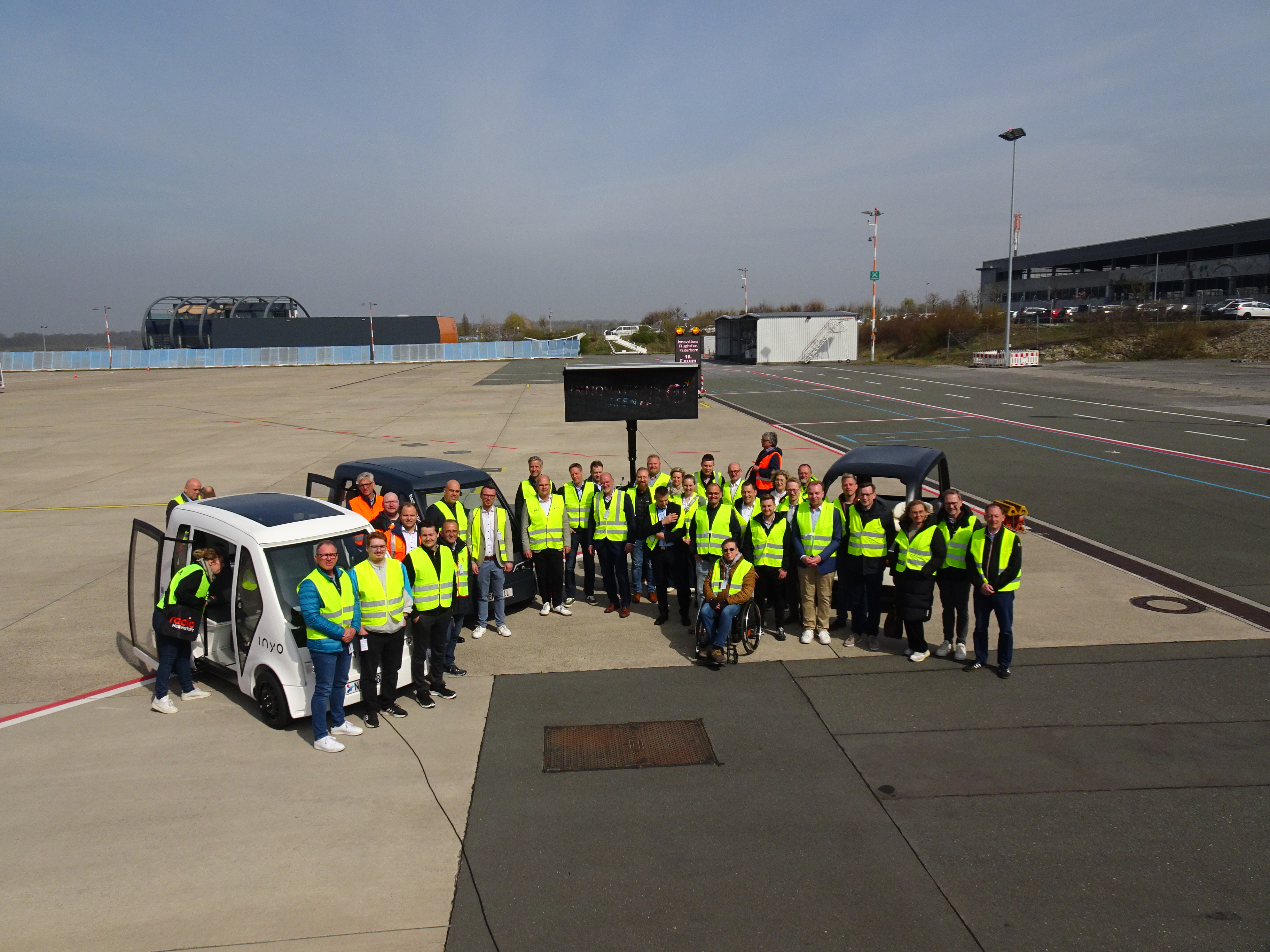
The New Mobility Paderborn (NeMo) initiative and the NeMo.bil project it initiated have reached the next milestone: the first manual demonstration drives of a NeMo.bil cab were carried out at Paderborn/Lippstadt Airport.
The ultralight demonstration vehicle completed its first laps on the non-public grounds of Paderborn/Lippstadt Airport in the company of the Management Board, members of NeMo e.V. and other project participants. The SICP - Software Innovation Campus Paderborn was also on site as a project partner to test the vehicle on the test site.
Dr. Christoph Weskamp, Head of the "Seamless Mobility" innovation area at SICP, and Philipp Speckenmeyer, research assistant at SICP, also presented key insights into the digital planning and optimisation components used to strategically and operationally design the mobility system.
NeMo.bil: Needs-based mobility in rural regions
As part of the NeMo.bil project, which is funded by the Federal Ministry for Economic Affairs and Climate Protection (BMWK) with more than 18 million euros, the participants are developing a mobility system for demand-oriented passenger and freight transport, which they will also demonstrate prototypically during the project period until 30 June 2026. To this end, NeMo.bil is pursuing an innovative approach with two automated vehicle types. Specifically, the system will look like this: Passengers enter their destination via an app and request a "NeMo.Cab". This small, very light and autonomous electric vehicle picks them up at home and heads for a (virtual) transport hub. There it joins up with other cabs to form a convoy. This convoy is pulled by a larger, also autonomous vehicle ("NeMo.Pro"). The NeMo.Pro is powered by hydrogen and also serves as a mobile charging station for the cabs, which can be recharged during the coupled journey. In convoy, the small vehicles and the Pro cover longer overland distances and can thus achieve greater ranges and speeds. For the "last mile", the Cabs uncouple from the convoy again to finally reach their individual destinations.
Automated test drives to follow
A total of 19 partners from industry and research are involved in the NeMo.bil project to bring autonomous driving to the road. With extensive work in the fields of development, engineering, approval and testing, the project is right on schedule. The first manual demonstration drives at the airport are the starting point for the test drive cycle. In the summer, NeMo.bil will present an automated cab, which will also be on the road with a safety driver in public areas shortly afterwards.
SICP develops intelligent planning for needs-based mobility
For the NeMo.bil on-demand mobility system to work well, journeys need to be cleverly planned and coordinated. This is precisely where the SICP comes in: The aim is to find out how to organise the interaction between the small cabs and larger Pro vehicles in the most cost-efficient and environmentally friendly way possible - while also paying attention to the needs of the passengers.
To this end, an intelligent planning system is being developed that helps to determine the right number and type of vehicles for a region and ensures that passengers reach their destination quickly, cheaply and in a climate-friendly way - for example, by using clever routes and convoys.
The big challenge: short journey times, low costs, high capacity utilisation and low environmental impact - these goals are often contradictory. Fewer vehicles mean lower costs, but also longer waiting times. More vehicles improve the service - but make it more expensive for providers.
This is why researchers at the SICP, under the scientific direction of Prof Dr Guido Schryen, are working on mathematical models and simulations to weigh up all these factors. This will enable mobility providers to make informed decisions later on - before the system is launched in reality.
"On the one hand, the planning problem is mapped as a mathematical model that is solved with the help of problem-specific heuristics. Secondly, a simulation is carried out that does justice to the dynamic decision-making environment of NeMo.bil," explains Professor Guido Schryen. "This simulation makes it possible to analyse the effects of different decisions on the overall system and thus plan efficient system operation before the decisions are implemented in reality."