etalytics
etalytics develops AI-supported software solutions for the optimisation of heating, cooling and ventilation systems. With the etaONE® platform, companies analyse and optimise their energy flows in real time, identify potential savings and automatically adapt operating strategies - without additional hardware. This allows them to significantly reduce their energy consumption, CO₂ emissions and costs while ensuring operational safety at all times. Founded in 2020 from the TU Darmstadt, etalytics combines research strength with industrial experience and supports data centres, the chemical and pharmaceutical industries and the automotive sector in particular on their path to greater energy efficiency and sustainable business practices.
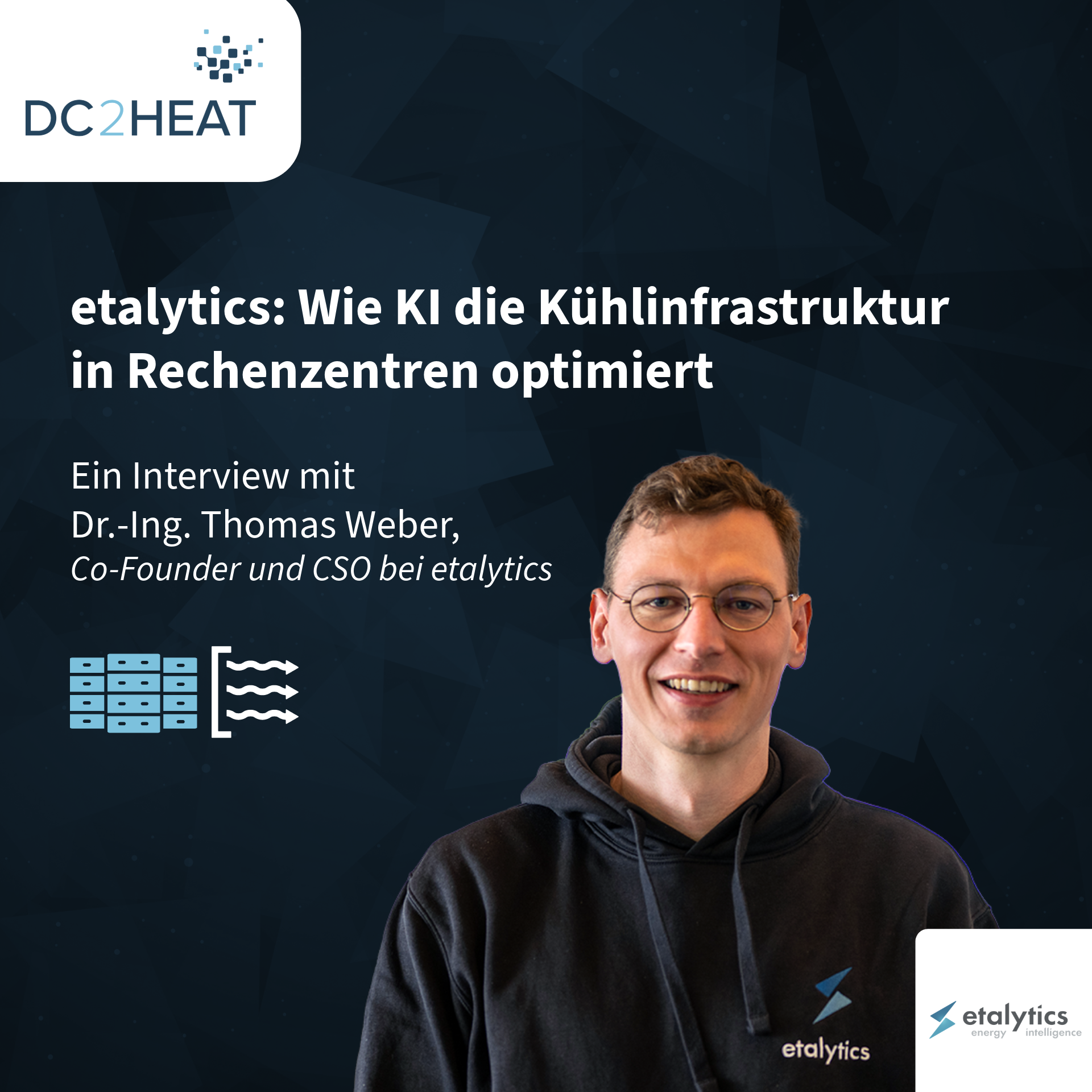
About Dr Thomas Weber
As founder and CSO, I am responsible for the growth and further development of our company. My personal motivation comes from my passion for innovative technologies and their potential to bring about real change. With my background in energy science and my research work at university, I co-developed the etalytics AI solutions.
You have developed software that uses AI to optimise the cooling infrastructure. So the efficiency of the energy supply in the infrastructure still had potential! How can you imagine the task of AI?
Imagine a conductor leading a large orchestra. Every single musician plays an instrument, and the conductor makes sure that all the instruments come together at the right moment, at the right volume and at the right tempo. If an instrument is playing too loudly or too softly, the conductor recognises this and can adjust it to achieve perfect harmony. etaONE® works in a similar way: the AI monitors a wide range of data - from electrical and thermal performance, temperatures and machine conditions to external factors such as weather conditions and energy price fluctuations. It ensures that each system component, such as pumps, cooling towers and heat exchangers, works at the right intensity at the right time to ensure highly efficient operation. This minimises energy waste and costs.
What are the limits of the current approach to controlling cooling systems? How does your AI-controlled control system overcome these limits?
Previous approaches have reached their limits because they are often static and inflexible. They are based on fixed setpoints that are rarely adjusted, even if external conditions such as temperature or humidity are constantly changing. This leads to inefficient operation and unnecessary energy consumption. In addition, these systems often rely heavily on manual intervention by employees who make decisions based on their experience, which can lead to further inefficiencies.
In contrast, etaONE®'s AI-driven optimiser uses real-time data from multiple sources to dynamically determine the optimal setpoints for each component of the cooling system. This allows the system to react immediately to changes and continuously optimise cooling without the need for manual adjustments.
In addition to efficiency, what other benefits does your AI solution offer in terms of data centre cooling?
Our modelling approach creates a detailed mathematical description of the system behaviour of the energy converters. The transparency created makes it possible to recognise faulty operating states of the energy converters, faulty sensors or progressive system wear and evaluate the negative effects. The optimisation model can also be used to simulate fictitious scenarios. What if I had more cooling towers? How would the system react at an ambient temperature of 40 °C and full capacity utilisation? This is where we help our customers make important investment decisions in their infrastructure.
Are there any fundamental or explicit challenges in using the software or new tasks that arise during operation?
Yes, there are a few points to consider, but overall our software makes operation easier. One of the most important prerequisites is sufficiently good data quality so that the AI can realise its full potential. This is where we support our customers in assessing and improving their data quality.
Using the software does not mean any additional, complex tasks for employees. On the contrary: the AI takes over many optimisation processes automatically, reducing manual adjustments to the systems. In our step-by-step implementation process, the AI only makes recommendations at the beginning, which the team checks and implements manually. This allows employees to learn how the AI works, why it makes certain recommendations and which optimisation potential it uses before the autonomous optimisation takes over completely.
We support and train the team at every step of the process to ensure that everyone understands how to use the software and feels confident. This not only makes operations more efficient, but also much easier to manage.
How is the industry and how are users reacting to your AI approach? Do you have to dispel concerns or scepticism or is there more acceptance?
We are seeing a mixture of enthusiasm and scepticism in the industry. On the one hand, there is great interest in the opportunities that AI offers to increase efficiency. On the other hand, the reliability of AI is always an issue, especially in the field of data centre infrastructure.
This is why we have opted for a transparent and gradual rollout: our software starts as a recommendation system so that our customers can familiarise themselves with the technology and intervene at any time if necessary. We show that control always remains with the operator - our software works in a supportive way and can be deactivated at any time if desired.
In practice, the result is usually convincing: if our AI controls the same processes more efficiently and measurably reduces energy consumption, acceptance automatically increases.
Has the Energy Efficiency Act influenced the development and use of your AI software, and if so, to what extent?
Yes, the Energy Efficiency Act definitely had an influence on the use of our AI software. The new requirements, such as the stricter PUE specifications and the obligation for more transparency in reporting, have presented data centres with new challenges and increased the need for efficiency solutions. However, it should be noted that we were able to acquire data centres as customers years before the Energy Efficiency Act came into force.
Overall, we are of course delighted that our solution is helping data centre operators to increase their efficiency, reduce their PUE and meet regulatory requirements at the same time.
Where do you see the future for AI in data centre cooling?
The use of AI in data centre cooling is still in its infancy. In the future, most processes in energy management and the monitoring and maintenance of components will be fully automated due to the extensive amounts of data. The complexity to be mastered will only increase with the extraction of waste heat, which is why the use of intelligent systems will be unavoidable in the future.
We still have a lot of work ahead of us here, but we believe the potential is enormous.
About DC2HEAT
In our digitalised society, data centres are indispensable for business processes and everyday digital life. Platforms, video conferencing and cloud computing require the operation of data centres whose IT consumes a lot of electricity. This generates more and more waste heat, which often remains unused.
DC2HEAT shows how waste heat from data centres can be used as an energy source to avoid fossil fuels and promote climate-friendly operation. The project identifies the sustainability potential of AI and investigates whether the results from Frankfurt am Main can also be transferred to other national and international locations and how waste heat can be utilised in a climate-friendly way.
The project is funded by the Federal Ministry for the Environment, Nature Conservation, Nuclear Safety and Consumer Protection (BMUV) as part of the AI Lighthouses for Environment, Climate, Nature and Resources programme.
The responsible project sponsor for the funding programme is Zukunft, Umwelt, Gesellschaft (ZUG) GmbH.